


This is an archived article that was published on sltrib.com in 2015, and information in the article may be outdated. It is provided only for personal research purposes and may not be reprinted.
Sandy • Kevin Curtis and Jake Adams stand adrift during a routine practice at Alta High. The heat is radiating off the artificial playing surface as players speed past in blurs, running routes around the two as they talk for the first time along the sidelines.
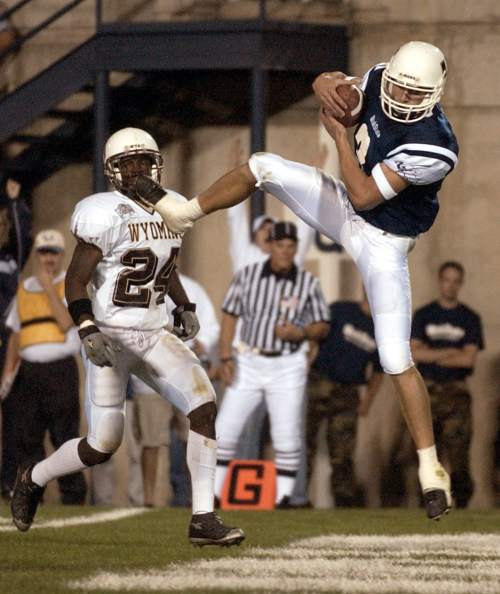
Curtis, who wrapped up his nine-year NFL career in 2011, is in his first season coaching receivers for the Hawks, while Adams is starting for the second consecutive year on the offensive line. They rarely collide during practice; often on opposite ends of the field or in separate position meetings, limiting opportunities to speak, but when the two realized they both belong to what Adams describes as "the club nobody wants to join" there were too many questions to not make time.
What type did you have? How long were your treatments? What kind of medications were you prescribed? How did that feel, did you lose your hair? How do you feel better now?
Are you cancer-free, too?
"Sometimes you never know who has it or who had it," Adams says.
Individual health concerns aren't readily discussed within the program. Adams was completely unaware one of his coaches had dealt with his own cancer scare. Curtis and Adams are treated the same as the rest of the players and coaches, and they wouldn't have it any other way.
"We approach these guys like they're anybody else, and that's the way they like it," said Alta first-year coach Alema Te'o. "They're like, 'Hey, don't treat me special. I'm here to grind, and that's what we're going to do.' "
Curtis discovered he had testicular cancer while he was playing in the NFL. During a physical examination as a free agent, a physician in Minnesota suggested he have a re-evaluation. Curtis wasn't concerned. He delayed the process for several years before eventually getting tested at the University of Utah. Originally he appeared in the clear, but over a three-year period, tests eventually showed positive results for cancer. Curtis underwent surgery, but last summer the cancer returned.
"It took about eight months to figure out what to do. I tried some alternative routes and then I ended up having to do chemotherapy," Curtis said.
Adams' experience was more direct. While playing football, he felt an abnormal bump near his collarbone. Pain worsened during the winter, so he had it checked. Tests revealed Hodgkin's lymphoma, the same cancer Kansas City Chiefs safety Eric Berry overcame.
"I was home when they called us; my uncle was my doctor," Adam says. "I had my whole family there; I felt defeated for a little bit. My whole family broke down crying. I hugged my mom, sat down on the couch, just trying to process [the situation]. It was terrible."
Adams endured three months of three-week cycles of chemotherapy, four days per week before two weeks of radiation. Less than two months into his treatment, tests showed he was free of active cancer cells. Adams was in remission.
The diagnosis of cancer immediately changes an individual, for better or worse. The outcome is never guaranteed, but Curtis and Adams both understood the power of remaining positive and the fighting spirit.
"We're all going to die. It was kind of one of those things where you try not to feel sorry for yourself. It's part of life," Curtis explains. "Put it in a higher power's hands and whatever happens is meant to be. I think that gave me peace of mind."
Both are cancer-free now, but the process is far from over. Years of monitoring and constant checkups are required, with the possibilities of cancer returning. For now — they're both back to the sport they love. Adams regained his strength and coordination, finally reaching the physical requirements to truly compete "a few weeks ago," while Te'o describes Curtis as a natural coach who is already building results with the Hawks' receiving corps.
"He's here to take our receiving corps to the next level. He has a great demeanor with the kids, and they embrace everything that he says," Te'o says. "His perseverance and commitment to these kids has been second to none. This helps him, it's therapeutic for him, to be out here, doing something that he loves and giving something back to the kids."
Adams asks his coach where he found the strength to overcome cancer again after believing he'd won the first fight. Curtis credits the thoughts of "healthier and better days" that motivated him. Adams nods his head in agreement. He envisioned the same moments during his darkest days, and as they stood, days away from another football game — it appeared the better days had finally arrived.
Twitter: @trevorphibbs —
"The club nobody wants to join"
Jake Adams is a senior offensive lineman at Alta. He overcame Hodgkin's lymphoma. Kevin Curtis is a former NFL athlete, now coaching the Hawks' receiving corps after two battles with testicular cancer.