


This is an archived article that was published on sltrib.com in 2010, and information in the article may be outdated. It is provided only for personal research purposes and may not be reprinted.
Kaysville • Each April, calculus students at Davis High sacrifice a Saturday to take a practice test.
About 300 students wear matching T-shirts, arrive at school by 7:30 a.m. and spend four long hours plowing through problems to prepare for real Advanced Placement (AP) calculus tests two weeks later.
"It's like practice game day," AP calculus teacher Tracey Meade said.
It's perhaps not surprising that Davis High had the highest participation and passage rates on AP tests in the state last school year, according to data released Monday. But Davis is not the only Utah school pushing more kids to excel. Statewide, 5 percent more kids took AP exams last school year than the year before, and the state's passage rate grew by nearly 2 percent to about 67 percent.
In all, 17,210 Utah students took AP tests and passed a higher percentage of tests than students in the nation as a whole. Students who score 3, 4 or 5 on the exams can earn college credit.
"It demonstrates how well we prepare our students for college and careers," said Brenda Hales, state associate superintendent. "This is part of what we're calling the Utah miracle because it's one of those returns on investment that the Legislature and taxpayers are getting for their education dollars."
Latinos, Utah's largest minority group, continued to be underrepresented among test takers, but showed significant improvement. For example, about 21.5 percent more Mexican American students took AP tests last year than the year before and passed nearly 10 percent more tests.
Almost all of Utah's minority groups showed growth this year in both participation and the number of exams passed.
"It's an indicator that shows we're starting to make progress with the achievement gap," Hales said.
She also said the state got a grant from the College Board last year that allowed it to give about 1,500 free AP tests to students who otherwise might not have been able to afford them.
Last school year, the tests cost $86 each to take.
But many students who do have to pay for exams say the cost is well worth it.
"It's cheaper to take it in high school and pay $85 for the AP test than it is to spend all the money in college for textbooks and the class," said Jessica Hansen, a Davis High senior who is taking two AP classes this year, including Meade's AP Calculus BC class, the highest level AP math class at the school. Hansen said she hopes earning college credit now will allow her to take a wider variety of classes in college.
"If I could get some college credit in high school, get that done, maybe in college I wouldn't have to take as many math classes," Hansen said.
Other students take AP classes in hope of boosting their chances of getting into certain colleges or earning scholarships.
Davis senior Spencer Groneman said he takes AP classes "to help with my grades, to get into school and have colleges notice the classes I took."
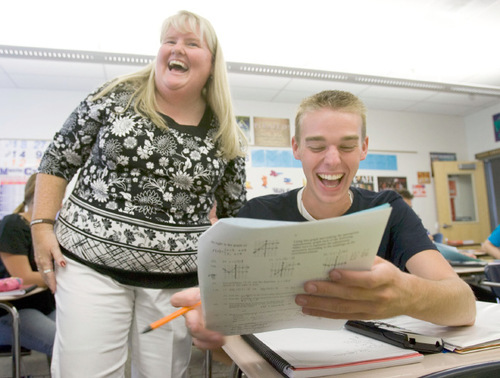
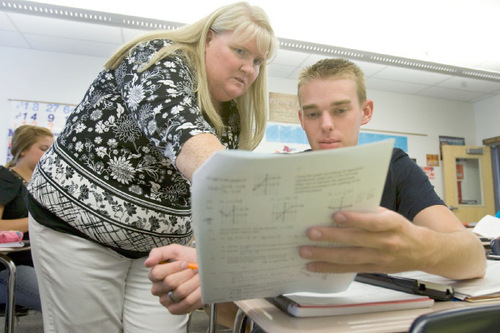
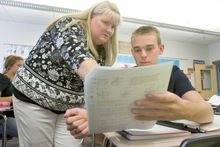
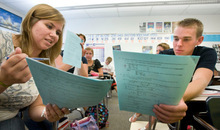
Meade, who spent Monday showing students methods for working with derivatives, said the classes also help prepare students for college-level work. She knows many of her students will eventually forget calculus, but she hopes the lessons of hard work and determination they learn stick with them.
"College credit aside, you get in almost all cases dedicated teachers who expect a level of rigor," Meade said. "There's just an expectation of responsibility and integrity on their part. They learn how to do hard things, which is preparing them for college in a big, big way."
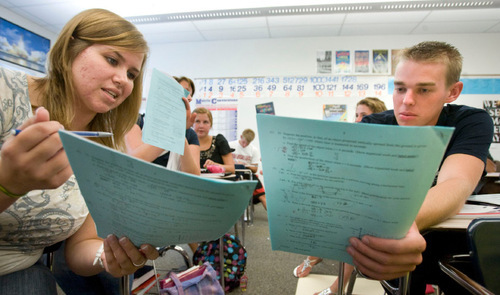
On Monday, about 30 students in Meade's AP calculus BC class listened intently as Meade showed them how to solve problems. Though school started less than a month ago, the students were already thinking about the AP exam, and Meade offered strategies for taking the test as she explained the math.
Meade said about one-fourth to one-third of the school's students take AP calculus. Davis High principal Dee Burton said the school invites all students to take AP classes and doesn't deny anyone the opportunity.
Lone Peak High, which had the fourth highest number of test takers in the state and the seventh highest passage rate, also allows all students who so desire to take AP classes, said Rod Campbell, Lone Peak head counselor and AP coordinator.
"We have a very open policy mainly because we want our kids to be able to have that kind of classroom experience and preparation for when they actually apply to college," Campbell said. "We just want the kids to be able to have a college experience while they're still in high school." —
Utah SAT scores also up
Fewer Utah students took the SAT college entrance exam last school year, but scores are up.
A total of 1,933 Utah students took the exam last school year, down about 4 percent from the year before. But Utah's average score went up in reading by 9 points, in math by 1 point and in writing by 7 points. Out of 800 possible points in each section, Utah students scored an average of 568 points in reading, 559 in math and 547 in writing, beating average scores nationwide.
Most Utah students take the ACT instead of the SAT because the ACT is accepted by Utah colleges and universities. The SAT is required to attend college in some other areas of the country. High schools with the highest numbers of test takers
Davis High School, Kaysville • 698
Alta High School, Sandy • 615
Park City High School, Park City • 571
Lone Peak High School, Highland • 526
Skyline High School, Millcreek • 518
Hillcrest High School, Midvale • 480
Brighton High School, Cottonwood Heights • 372
Highland High School, Salt Lake City • 363
Riverton High School, Riverton • 362
Weber High School, Pleasant View • 356
High schools with top percentages of tests passed
Davis High School, Kaysville • 86.8 percent
Bountiful High School, Bountiful • 85 percent
Brighton High School, Cottonwood Heights • 80.7 percent
Mountain View High School, Orem • 80.3 percent
Olympus High School, Holladay • 79.9 percent
Timpanogos High School, Orem • 79.3 percent
Lone Peak High School, Highland • 78.5 percent
Timpview High School, Provo • 78.3 percent
Viewmont High School, Bountiful • 78.2 percent
Itineris Early College High School, West Jordan • 76.9 percent