






This is an archived article that was published on sltrib.com in 2010, and information in the article may be outdated. It is provided only for personal research purposes and may not be reprinted.
Who knew that an obnoxious, scruffy guy dressed as a giant tongue would prove a huge marketing success in the age of the Internet.
But that's what is going on with a tiny Utah company that sells a single product — a brush to clean the bacteria off your tongue and prevent bad breath.
The Orabrush channel on YouTube is the site's fifth-most subscribed of any commercial sponsor, ahead of Disney, Wii, Burger King and Nikesoccer, and just behind No. 4 Apple.
"We'll pass Apple soon," said Jeffrey Harmon, the company's 28-year-old chief marketing officer.
Orabrush's videos have been watched more than 30 million times. More than 250,000 people follow the Provo company's Facebook page.
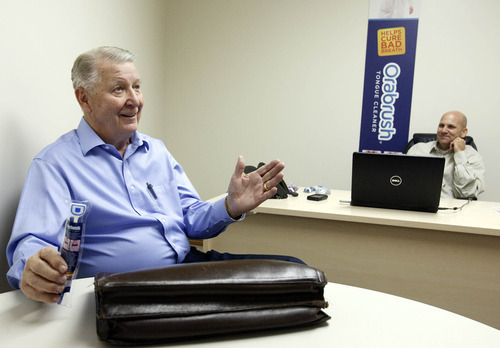
Orabrush, founded by 75-year-old Robert Wagstaff, has sold more than a million dollars worth of the brushes (suggested retail price $4.99) over the Internet to customers in 114 countries. Britain's largest pharmacy chain has called saying customers were asking for the product and wanted to stock it.
It's heady success for a company with 15 employees who work out of a set of less-than-luxurious offices down a dingy hallway next to a barber shop in downtown Provo. It's also a window on how small companies now have the ability to market products and compete with even international powerhouses.
For all that, Orabrush's new-found success was almost accidental.
—
A marketing vision • In 2009, Harmon was in his last day in class in the last semester of his last year at Brigham Young University, listening to a presentation of fellow students in a marketing class. They had taken on a study of how Wagstaff might market the tongue cleaner he had invented after he had heard a complaint about the bad breath among Mormon missionaries he was supervising in the Philippines.
Wagstaff had turned to the class in frustration after failing in efforts to get sales to go beyond about 100 units with a $40,000 infomercial. He also had approached Wal-Mart Stores Inc., Walgreen and other retailers without success. Oral-B and Colgate declined to buy the patent.
According to Harmon and Wagstaff, the BYU students recommended that Wagstaff not use the Internet to market his single product. Harmon disagreed and told Wagstaff after class that the Orabrush could be sold via the Web.
Last year, Wagstaff, Harmon and Harmon's brother, Neal, formed Orabrush — a company with an little-known product and very little money to market it.
But unlike, say, six years ago, the Internet now provides free, multimedia communication that holds great promise for marketing for smaller companies, while the emergence of smart phones has created platforms for doing so.
"If they're willing to dive in and immerse themselves in the mediums, the new mediums that exist on mobile phones, on YouTube, on Facebook, on all these different platforms, they can compete with the big guys," said Harmon.
—
YouTube as a branding tool • But how? YouTube, which is owned by Google Inc., says hundreds of thousands of videos are uploaded to the site daily and that about 2 billion videos a day are viewed. Getting enough eyes on any one video is a challenge.
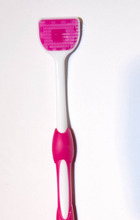
To introduce the Orabrush, a toothbrush-like instrument but with softer, shorter bristles on a wider head, Harmon recruited BYU graduate Austin Craig to refocus his rants about politics and other subjects, and turn his attention to bad breath in hopes of producing a short video.
"We did it after work one day," said Craig.
"Bad Breath Test" was shot in a pool hall for less than $500 with a crew of four — Wagstaff held the microphone, a former Harmon roommate did the filming.
"We tweaked it and tweaked it, and by October we had sold out of the product, " Harmon said. "It was going crazy."
That first bad breath video has been viewed 13 million times.
After attending a conference of YouTube users, Harmon and others realized they needed deploy a channel on YouTube as a branding tool rather than focusing just on videos whose aim was direct sales.
Another Harmon brother, Daniel, came up with the idea of a tongue character. Jeffrey Harmon said he immediately saw that the group could create a series of short videos around the character.
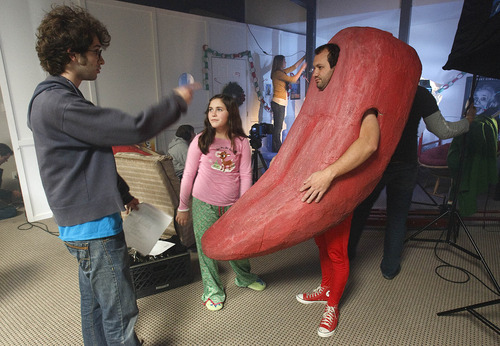
They recruited Salt Lake City comedian David Ackerman, who was dressed up in a giant pink foam tongue to play an insensitive slob whose antics are followed in weekly installments.
"Diaries of a Dirty Tongue" has been on YouTube since August, with an average of about 50,000 views each week. Ackerman's brother, Joel, another former roommate of Jeffrey Harmon, writes and directs the series, whose shooting locations include a room in the Orabrush offices that was converted into a studio with items bought on the cheap.
—
Turning customers into marketers • The "Diaries" don't mention Orabrush directly. Rather, Harmon said, they create an "experience."
"We wanted an emotional experience where people have a friendship and a connection with our brand," he said. "You have to figure out a way to create an experience that people want to share. If it's a good enough experience, then they'll share it with a friend."
Orabrush claims great success in converting its YouTube site into sales, providing viewers numerous opportunities to click on promotional videos, take a bad breath test and go to the company's own website to order.
That's the point of Orabush's iPhone app. If you blow into the bottom of the smart phone, it displays a "reading" showing you have bad breath. The trick is that actually it's the sound the breath makes that triggers the phone to play a message such as, "I feel violated" and "Has anyone ever told you your breath smells wonderful? They never will." But the jokes are a marketing tool because iPhone owners have to use it on someone for it to work.
"So you're turning your customers into your marketers," said Harmon.
On Facebook, the company posts links to its videos and asks questions about its products. When Harmon wanted to change packaging, he put up two proposed designs and got feedback from several hundred users.
Social media tools have created an alternative marketing model, said Jeff Davis, who became CEO of Orabrush in August. Davis spent 23 years at Procter & Gamble, retiring as vice president and general manager of global operations.
"Normally," said Davis, "you have an idea, you build a prototype, you do a test market, you scale for capacity, you launch in to retail. You then begin to turn on your advertising and hope people create a level of awareness and engagement to try the product."
In launching its product, Orabrush did the opposite.
Orabrush went first to Facebook and YouTube with its product, creating an awareness and image that also depended on feedback from viewers and users in the comment sections of those two sites.
"We allow them to literally participate in the development of the strategy for the company in that sense," said Davis. "They literally are honing the strategy of the company in a real-time way."
Walmarts in Utah have begun to stock the Orabrush after a store manager took an interest in the product. Orabrush has permission from Google, YouTube's parent, to put the words "As Seen on YouTube" on its packaging.
"This product potentially can be used by every person on Earth," said Wagstaff.
One key to the marketing efforts is to have fun. The Thanksgiving week "Diaries of a Dirty Tongue" episode featured Morgan's take on the holiday.
As an Orabrush ad popped into the bottom of the video window, Morgan, sitting in his apartment, spouted: "Don't you hate how every time Thanksgiving rolls around somebody has to ruin it by saying the 'never-ending' grace. Come on, Grandma, it won't be long before you're talking to God in person. So just save it!"
Then he mutters in a low, slow cadence, "Sorry, Grandma. We're glad you're alive."
Inventing the Orabrush
R Robert Wagstaff — called "Dr. Bob" by Orabrush's staff of 20-somethings — said he invented the Orabrush for the tongue after getting a complaint about bad breath among Mormon missionaries while he was a mission president in the Philippines from 1998 to 2001.
Wagstaff, 75, who has a doctorate in nutrition and biochemistry, said he realized that brushing your teeth doesn't cure bad breath because up to 90 percent of bacteria comes from the tongue, citing a study by the dental school at the University of Buffalo.
Because of a project he once worked on to try to eliminate salmonella from the skin of butchered chicken, Wagstaff said he realized "there is no way you're going to remove the bacteria that causes bad breath on your tongue with a scrapper or with a toothbrush. I can create a better mouse trap."
So he started with a surgeon's scrub brush — the only thing that could successfully remove salmonella from chicken skin — and created a brush with soft bristles and a scrapper that reaches into the crevices of the tongue and pulls out the offending life forms.