


This is an archived article that was published on sltrib.com in 2010, and information in the article may be outdated. It is provided only for personal research purposes and may not be reprinted.
The wall appeared after two months. Jazz center Mehmet Okur had faced and overcome seemingly overwhelming obstacles before.
But nothing like this.
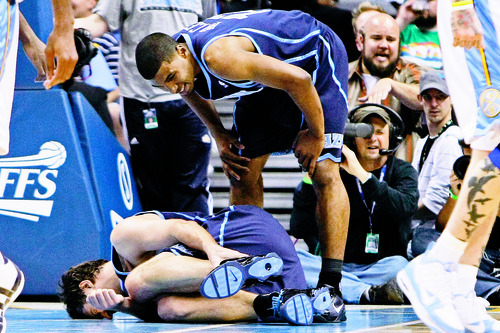
His mind wandered and drifted. His atrophied body was gradually betraying him. Just two months after a damaged, broken Okur was carried off the court April 17 during Game 1 of a first-round playoff series against Denver, one of the NBA's unheralded Iron Men was slowly turning into blubber as he recovered from a ruptured left Achilles tendon.
All the 6-foot-11, 265-pound Okur could do was watch television. There was no running, no jumping, no shooting. After playing 604 regular-season games during the first eight years of his career — averaging 75.5 per season, only missing 52, and hitting the full 82-contest mark twice — Okur's brain began to explore dark thoughts that it had never coveted before.
Retirement still sat on the precipice. But worry, concern and a flirtation with frailty stood tall in the center of his head.
Six months later, Okur refers to the wall as a nightmare.
"I was like, 'Am I going to be OK?' " he said.
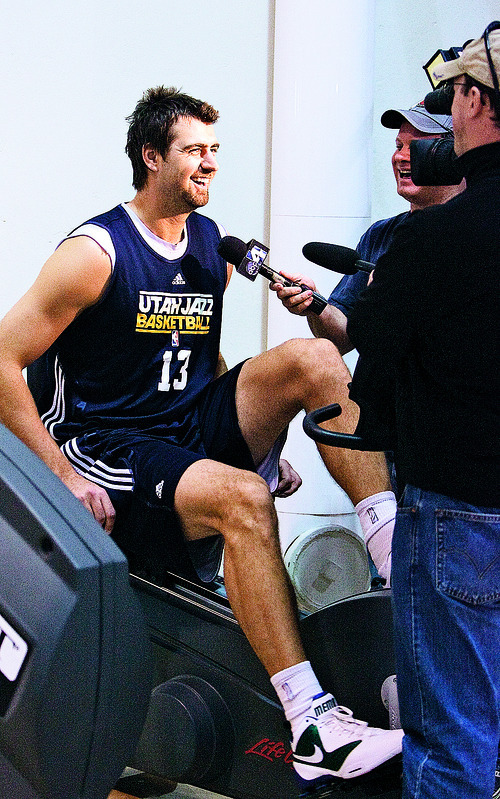
Eventually, yes. Today, the 31-year-old center from Yalova, Turkey, is closer than ever to being 100 percent healthy. He made his season debut Dec. 17 against New Orleans, while his confidence and conditioning are at an eight-month high.
But to reach the peak — and simply return to his previous form — Okur's journey required trust, patience and commitment from the Jazz; his own increased self-discipline; and a series of strenuous, at times highly frustrating workouts at Peak Performance Project, a state-of-the-art athletic facility in Santa Barbara, Calif.
Okur's rehabilitation was so fragile and uncertain that Utah general manager Kevin O'Connor consistently refused to put a public timetable on his activation, while P3 director Marcus Elliott conceded that the center initially showed up in sunny California looking like an absolute mess.
"His whole body had lost a whole lot," said Elliott, who estimated that Okur's left calf was at 50 percent strength when he arrived at P3 in late August.
He added: "You worry about these Achilles repairs. It's a major surgery. It's one of the strongest tendons in the body — maybe the strongest."
And Okur had no strength.
Major project
Okur's humor was gone and his optimism was fading. He was being pushed hard and he hated it. While many of his teammates were wrapping up lazy summer vacations as August turned into September, preparing to return to Salt Lake City for training camp for the 2010-11 season, Okur was sweating buckets and battling fear.
Elliott's P3 facility was attempting to target exactly what the center had left in his body and how far he had fallen. But to fully evaluate him, pinpoint a starting point, and then slowly ramp up his workload, Okur first had to bottom out.
The ground broke when he acknowledged that he no longer trusted his surgically repaired left leg.
"We've done a lot with him to give him confidence that he can actually load this thing and do basketball. And it takes a while for his brain to believe that," Elliott said. "And so we tried to accelerate that process. [With] a big injury, part of the thing you have to recover from isn't physical, it's also psychologically trusting yourself."
By the five-month mark, Okur's self-belief had finally returned. He had bought into P3's strict regimen, and his fear had been replaced by determination. Soon, he was hoisting up his trademark 3-pointers like April 17 had never happened.
"From that point, I start to go hard every day because I got my confidence back," Okur said.
Utah coach Jerry Sloan compared Okur's P3-fueled comeback to the evolution in his game that bridged the 2004-05 and 2005-06 seasons. Okur's first year with the Jazz was an unequivocal struggle, highlighted by a lack of conditioning. Where some players would have spent the summer hollowing out a larger hole, Okur promised Sloan that he would return with better lungs and a stronger body.
"I said, 'I'll wait and see,' " Sloan said. "He did the work, and his career kind of took off."
Six years later, Sloan heard the same vow. And like many within the Utah organization, he praised P3's involvement with Okur, as the center was able to take long-legged strides during the final three months of his rehab that otherwise would have been unattainable.
"When you're not out there playing, that's a tough thing," Sloan said. "Everybody can say, 'Well, I worked hard; I did this.' But you don't get the basketball part of it. It appears to me they're able to break the body down and do things that really keeps you going."
New future
The Jazz have at least 52 regular-season games and four and a half months' worth of basketball remaining during the 2010-11 campaign. Okur missed the first 26 contests and initial two months of action. But to everyone from Elliott to O'Connor, Okur is on schedule — if not ahead of it.
"He's ready go to play basketball right now," Elliott said. "I think the rest of his body works better than it did before he got hurt, and his left Achilles is 90 percent-plus."
Jazz head athletic trainer Gary Briggs acknowledged that Okur is still not 100 percent. But after playing two contests without soreness prior to spraining his right ankle last Monday during pregame warm-ups in Cleveland, Okur is as close as he has been all year to looking like his old self, Elliott and other key Jazz personnel say.
And in that statement is a clue. Elliott said that Okur has found a minor fountain of youth as a result of his time at P3 and the intense self-evaluation that followed.
The 2009-10 season marked a five-year low for Okur in average points, rebounds, assists and minutes. His nine-year career appeared to trending downward, which, when combined with the fact that his contract with the Jazz expires after the 2011-12 season, raised questions about how long the fan favorite would remain in Utah.
"This kind of injury makes you step back a little bit," Okur said. "You have to step back to realize you want to go hard and you want to be smart at the same time. That's what I've found and that's what I'm feeling. Sometimes the fans don't understand that. Some fans they say, 'OK. It's been eight months. He should be good to go.' But it doesn't work like that."
But after climbing over his two-month wall and then enduring six more months of sweat, frustration and pain, Okur is sitting on a secret. In June, he could have easily reached out and pressed the stop button on his career if he wanted to give into the temptation. Now, he's thinking about running the court as long as possible until his body finally says no.
Elliott believes that the next three season of Okur's career could be his best to date. Meanwhile, Sloan joked that he thinks Okur will still have the ability to swish 3s from a wheelchair when he is 70.
The long-range expert acknowledged that seven decades might be tempting fate.
But what about four?
"To be honest with you, I'm not [an] above the rim guy," Okur said. "With my shooting touch, I should be able to go 'til 40. … As long as I have my shooting touch, I want to play."
Okur file
Position • Center
Vitals • 6-foot-11, 265 pounds. Season • 9
Numbers • 13.8 points, 7.1 rebounds, 1.7 assists, 46 percent field-goal shooting, 37.8 percent 3-point
Hometown • Yalova, Turkey
Teams • Utah, Detroit —
Iron Man
Prior to his Achilles injury, Mehmet Okur had never missed more than 11 games of an 82-game regular season:
Season GP
2002-03 72
2003-04 71
2004-05 82
2005-06 82
2006-07 80
2007-08 72
2008-09 72
2009-10 73
2010-11 2*
*Missed 28 due to injury —
Trail Blazers at Jazz
P Monday, 7 p.m.
TV • FSN Utah