


This is an archived article that was published on sltrib.com in 2011, and information in the article may be outdated. It is provided only for personal research purposes and may not be reprinted.
Steep tuition increases and unprecedented enrollment caps could be in store for Utah Valley University students if the state doesn't make critical investments in the fast-growing school — now facing its third straight year of budget cuts while coping with historic enrollment gains.
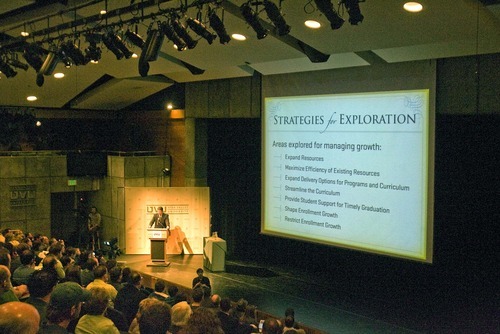
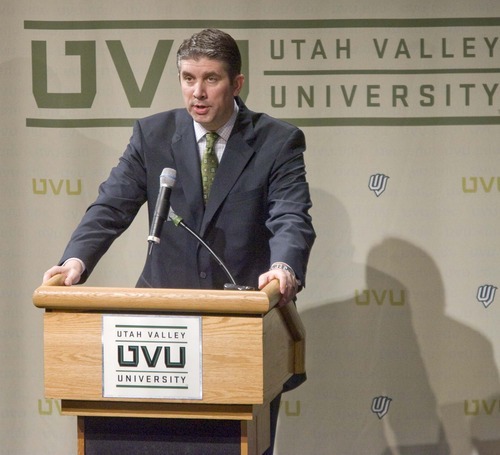
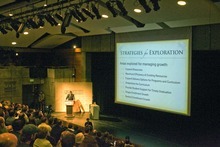
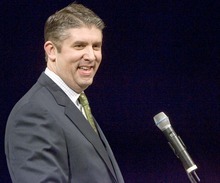
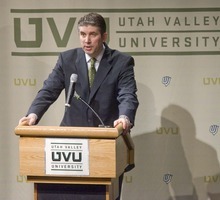
At his annual "state of the university" address Wednesday, UVU President Matthew Holland identified thresholds the Orem school must meet if UVU is to serve the 46,000 students expected by 2020.
"It does students no good to welcome more and more of them with open arms only to fail them in providing meaningful educational experiences and reasonable avenues to timely graduation," Holland told an audience of students, staff and faculty in the student union's Ragan Theater. He wants to hire more than 600 professors, most of them tenure-track, and 500 staffers, which would require a $46 million increase in state funding to pay them and three new buildings to house them. And 5,000 more parking places would be nice.
Student leadership applauded his message.
"It was a brilliant speech. He's very in tune with the students' needs, but also the needs of the community and the state. He understands how we have fallen behind in education on a national level," said student president Richard Portwood.
Holland's remarks come two days after the legislative Higher Education Appropriations Subcommittee formally endorsed a 7 percent reduction in spending, which would trim $47 million from college and university budgets in 2012. UVU's share would be $4.3 million, but Holland is confident the Legislature will lessen that amount by the end of the session.
"It's still the wrong direction," Holland told reporters after his talk. "Even the governor's proposed flat budget is a cut for UVU given we are likely to take on additional students this fall. … This is a difficult time to cut budgets and still maintain quality education."
The challenges UVU faces are not unlike those at the state's seven other colleges and universities. But UVU must accommodate an ever growing number of students with fewer facilities and less state support than any other school.
Still, Holland emphasized the state of UVU is "sound."
UVU will play a key role in meeting the state's goal of increasing the share of the population with post-secondary certification from 39 to 66 percent — but only if it has the needed resources, Holland said.
That requires money, and some will come from students who have seen college become less affordable each year.
Holland expects the university's share of the 2012 tuition hike will range from 4 to 9 percent. Coupled with the 3 to 6 percent the Board of Regents is expected to impose, that makes for a worst-case 15 percent hike at UVU.
Although a $600 spike in tuition would strain most UVU students, the most unsettling scenario Holland described was limiting admissions. Such a move would defy UVU's role as an open door to an undergraduate education, closing off the school to poor achievers.
"It's on the table as a tool of last resort," Holland said. UVU's inclusivity is central to its unique role in the Utah system and should be preserved, but not at the expense of quality. "We should plan to accommodate as much of the demand for higher education in our region as we can, as long as we can get sufficient resources to maintain a robust university infrastructure and climate," he said. —
By the numbers UVU statistics
2008 Utah Valley University in Orem became a university.
32,000 Students enrolled at UVU in 2010
46,000 Projected enrollment in 2020
$4,300 tuition and fees for 2010-11.
42% Portion of operating budget covered by state
$2,800 Annual state spending per student
50% Portion of courses taught by adjuncts
Source Utah Valley University