


This is an archived article that was published on sltrib.com in 2011, and information in the article may be outdated. It is provided only for personal research purposes and may not be reprinted.
A new, get-tough policy against riders who dodge fares on Utah Transit Authority trains and buses both cut the estimated number of scofflaws by a third last year and quadrupled revenue from fines.
That's according to UTA data requested by The Salt Lake Tribune.
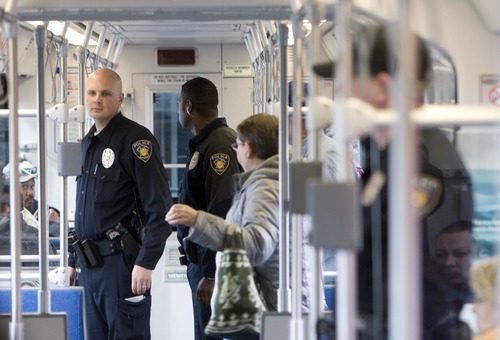
"In 2010, UTA adopted a zero-tolerance policy for fare evasion," said UTA spokesman Gerry Carpenter. UTA police ticketed anyone they found without proof of paid fares on TRAX or FrontRunner trains or MAX bus rapid transit (where drivers don't collect payments upon entry).
"Prior to that time, UTA would typically issue a warning to first-time violators and only cite repeat offenders," Carpenter said.
The change appears to have made a significant difference to UTA revenue.
First, revenue from fines paid by scofflaws quadrupled — from $22,402 in 2009 to $82,933 in 2010. That came as UTA's police issued 8,972 tickets for fare evasion in 2010 compared to 6,916 in 2009.
Second, the estimated percentage of fare violators dropped by 29 percent — from an estimated 1.97 percent of all riders to 1.39 percent — meaning more people are paying fares as word spread about the get-tough policy.
The evasion rate is calculated by comparing the total number of passengers asked for proof of paid fares by the number of violators found.
In 2009, UTA police asked 855,914 riders for proof of fare payment, and 16,828 were in violation.
In 2010, they asked 711,011 riders for proof, and 9,858 were in violation.
Carpenter said failure to provide proof of fare payment is an infraction under UTA ordinances, and the fine is equal to two times the cost of a regular adult monthly pass (which has been $134, but rises to $150 after new fare hikes take effect on Sunday). Money is paid directly to UTA.
However, "At UTA's discretion, first-time offenders may be invited to take a public safety class at a cost of $25 in lieu of paying the fine," Carpenter said.
He added that UTA used to offer about two such classes a month. But after the get-tough policy took effect, it increased the frequency to about eight a month — with about 20 students each.
"One of the challenges we have is that first-time offenders are not always proactive in paying their fines," Carpenter said. "We find we may be more successful in collecting fines when we offer them the chance to pay $25 and take the class, and then hopefully they will not offend again."
He said UTA goes after nonpayers of fines by using collection agencies, "but we have about the same success rate as anyone who uses a collection agency."
It also on occasion bans people with outstanding fines from using its trains and buses, and charges any of them who violate that with criminal theft of services and criminal trespass — and pursues those charges in justice courts.
Data show that most violators have been found on TRAX trains — 7,886 were cited in 2010, up from 5,634 in 2009.
On FrontRunner commuter trains, 984 were cited in 2010, down from 1,232 in 2009. On MAX rapid transit buses, 102 were cited in 2010, up from 50 in 2009.
UTA Police do more than search for people who evade fares. It reported issuing 260 arrests or citations for crimes against property during 2010, and 95 for crimes against people, such as assault or robbery.