




This is an archived article that was published on sltrib.com in 2011, and information in the article may be outdated. It is provided only for personal research purposes and may not be reprinted.
Maple Canyon • Tim Charlwood is among those who still views the Ogden Valley as an undiscovered paradise, though the shock of Utah's real estate crash and foreclosure wave has brought that vision closer to earth.
The British land developer is selling home sites in an exclusive 524-acre, eco-friendly mountain retreat-turned-subdivision, east of Huntsville.
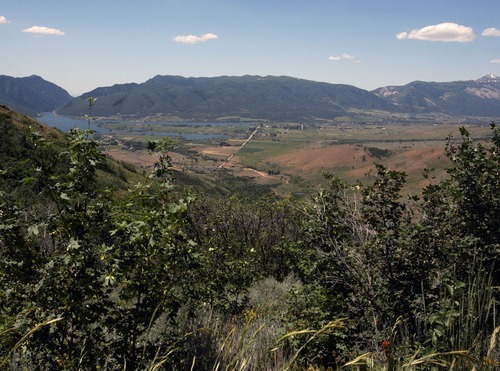
Notched into a deeply wooded mountainside at the top of Maple Canyon and crisscrossed with nine miles of trails, the Sanctuary enclave offers luxury home sites with names such as Cambrian Ridge, Kokopelli Lookout and Curtain Bluff.
Each of the project's six partly developed lots boasts a stellar view from more than 5,600 feet above sea level, is surrounded by 40-plus acres of private forest and retails for $850,000 to $1.75 million. Charlwood, who lives near Park City, launched the project in 2004, when land prices all across this pastoral valley were starting to soar.
Today, his development is listed at a quarter of its appraised price of a little more than a year ago.
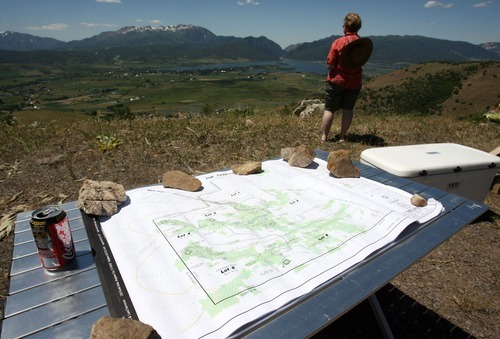
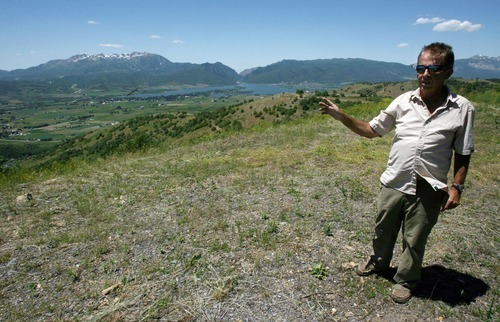
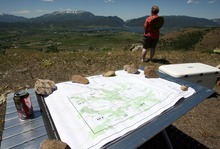
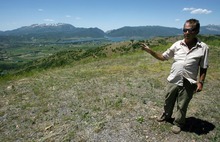
"I've had to get very realistic about valuations," the U.K. import-export entrepreneur and real estate developer said Thursday while welcoming visitors at a mountaintop gathering to promote the sale.
"But we're not selling typical properties you would find at the floor of the valley,'' he said, sweeping an arm across a spectacular horizon-to-horizon vista. "We have something that is completely unique."
Theactual number of foreclosures has been tiny in Eden, Huntsville and adjacent areas when compared with more densely populated and depressed housing markets in Salt Lake, Utah and Washington counties. Forced bank auctions have ranged in the dozens to scores as opposed to the many hundreds or thousands in places such as Salt Lake City, South Jordan, St. George, Herriman or Saratoga Springs.
But as a share of total housing units — as measured by the 2010 U.S. Census — these small and verdant communities east of Ogden have suffered some of the highest foreclosure rates in Utah.
In some hard-hit pockets, including several Eden subdivisions, more than one of every three homes has been listed as "real estate owned" since mid-2007, meaning a lender foreclosed on the property but couldn't find a subsequent buyer. Much of the trend, according to residents, has involved second homes bought after the 2002 Winter Olympics by out-of-state vacationers subsequently forced to cut their losses with the recession.
"Most of the people that I know that aren't around anymore are from California," said Jim Halay, proprietor of Alpine Pizza in Eden.
The region reveals a facet of the state's foreclosure crisis in which defaulting homeowners give up an asset viewed as a luxury or an investment rather than a primary shelter — and then vanish from the community. Similar patterns have emerged in other markets heavy with second homes, such as Park City and St. George.
But the Ogden Valley is distinct in ways that may have made it more vulnerable. With its proximity to Snowbasin (home of the 2002 Olympic downhill races), Powder Mountain and Wolf Mountain ski resorts, the area was seen as a more secluded, down-home and less expensive alternative to Park City and Deer Valley.
"Up there, the bazillionaires bought places for $5 million in cash,'' Halay said. "Here it was different. Here, everyone seemed to have a second mortgage.''
Many vacation homes in the Ogden Valley had traditionally been owned for generations by families in Salt Lake City, Ogden and counties adjoining Weber County. But the market changed with pre-Olympic improvementsto Snowbasin and the 2005 merging of Wolf Creek Resort, site of a championship golf course on the northeast side of Eden, with Nordic Valley Ski Resort into what is now an all-seasons facility.
An ensuing and well-funded marketing campaign highlighted the valley to a well-heeled national audience, specifically targeting out-of-state ski vacationers. That, in turn, drew an influx of homebuyers, particularly from California, Florida and Vermont, which boosted housing demand and land values.
By all accounts, developers jumped in with both feet.
"It was chaos," said Steve Clarke, an 11-year resident of Eden and head of a grass roots group pressing for managed growth in that neck of Weber County. "Every planning meeting you went to, there were several subdivisions going in, with 70 to 90 units each. And so many of those collapsed right at the peak of the market."
Some homes in Eden, Huntsville and environs saw price appreciations of 40 percent to 60 percent a year — while the boom lasted. And the bursting of the housing bubble has been equally breathtaking.
Huntsville resident and real-estate executive Gage Froerer recalled two recent and sizable land deals in which parcels that once commanded $80,000 to $100,000 an acre were sold for $2,500 to $3,500 an acre.
"If you bought after 2003, you don't have any equity in your home,'' said Froerer, also a state legislator representing the area. "We're really back to early-2000 pricing in Ogden Valley."
While scores of families have left, all the key attractions that fueled the construction boom — stunning mountains, ski resorts, Pineview Reservoir, year-round recreation and an Audubon Society-certified golf course — are still here, a little more than an hour's drive from Salt Lake City.
While not minimizing the pain of the recession, some residents are relieved a more substantial housing boom didn't overwhelm the area's small-town feel.
Census figures peg the number of housing units in Eden at 204 and Huntsville at 249. Charity garage sales are featured on the local newspaper's front page, and kids ride their bikes in the July Fourth parade.
"It's a quiet atmosphere, which is why I moved here," said Halay, a former Chicago resident who fell in love with the area during a four-day visit in 2001. "It's a great place, but don't tell anybody about it.''