



This is an archived article that was published on sltrib.com in 2011, and information in the article may be outdated. It is provided only for personal research purposes and may not be reprinted.
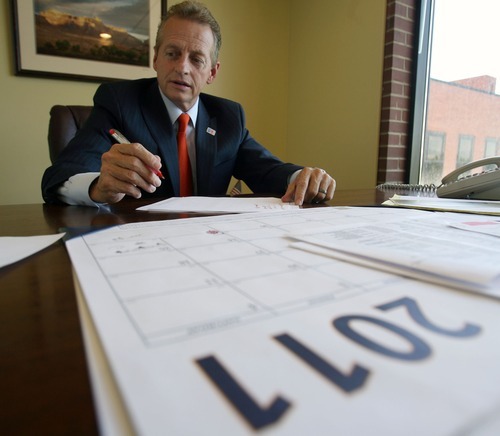
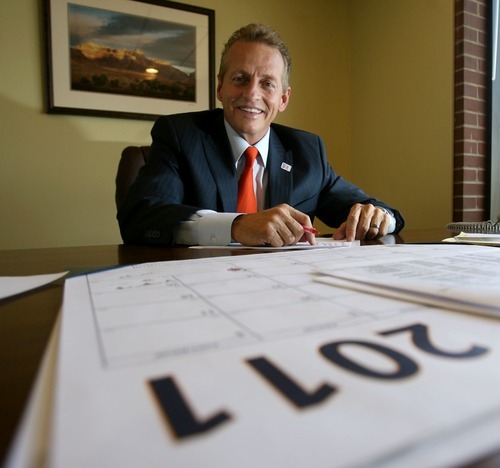
Wayne Holland spent years building the Utah Democratic Party piece by piece, shaking the money tree, cajoling candidates into long-shot bids and trying to sow the seeds of a grass-roots movement.
Any progress he made was no match for the unprecedented 2010 Republican tsunami.
Despite that setback — and the fact that Republicans are as dominant as ever in the state — Democratic leaders praise the work he has done. As Holland prepares to turn over the keys to the party Saturday, they argue Democrats are better prepared to compete than before.
"What he's done is create more of an infrastructure in the party, attracted more candidates, recruited people to fill more races than we have in the past. He's moved the party forward in that regard," said Rep. Jim Matheson, who asked Holland to take the job six years ago. "I think they'll be in a stronger position based on what he has done."
Salt Lake City Mayor Ralph Becker said Holland worked hard on the "nuts and bolts" of organizing, recruiting and fundraising while focusing on the party's long-term future, which will benefit the next chairman.
The problem Holland has been unable to overcome, Becker said, is the straight-ticket GOP vote, which has scared off potential Democratic candidates.
"As someone who's been involved in this now for 15 years, I don't know what it's going to take for there to be a wake-up call. It's not due to a shortage of failures by the Republican Party," said Becker, a former state lawmaker. "For whatever reason, too many voters in Utah have not been willing to even consider Democratic candidates, and it's a very unhealthy democratic condition for this state."
Former Utah Republican Party Chairman Dave Hansen said Holland tried to prevent the party from going "off the deep end" on issues and keep it as a viable alternative to the GOP.
"He is a dedicated Utahn and a dedicated Democrat, and I think he has done a lot for the party during his tenure," Hansen said. "You can't measure it just in victories and polls. I think he's done a great job in holding his party together."
Holland leaves the Utah party to take a position organizing Western states for President Barack Obama's re-election bid, although the job specifics are still being hashed out.
It's not far from where Holland was in 2004. Then a longtime union organizer, he spent four months on the road, campaigning in surrounding battleground states for the Democratic presidential nominee, John Kerry, which ended in a bitter loss.
"The drive from Pueblo, Colorado, back to Salt Lake the day after the 2004 election, was like, oh, a deep ache. You just felt like there was something more we could have done to push this thing over," he said. "There was unfinished business."
So when Matheson asked Holland to consider the state post, he agreed.
During his six years, he was a prolific fundraiser, drawing on a handful of deep-pocketed donors and growing the small-contributor network to help Democrats put more money into party coffers than the state GOP did in the 2008 and 2010 elections — a rare feat for the minority party.
While Utah hasn't been a swing state in presidential runoffs for about half a century, Democrats here still tried to make an impact, sending more than 850 young people to Colorado and Nevada to canvass neighborhoods for Obama, who ended up winning both states.
Pat Waak, then-chairwoman of the Colorado Democratic Party, said the effort in western Colorado "needed every single volunteer we could get," and it helped that the workers were from the West.
"The massive numbers made a difference for us," she said. "The commitment that Wayne and the party made to Colorado was very, very important to us."
Holland said the young workers would arrive at the party's Salt Lake City headquarters early in the morning with sleeping bags and car-pool to a neighboring state. In Colorado, they knocked on 100,000 doors. But part of the deal was that they would have to walk neighborhoods for Utah candidates as well.
Some of them still show up at party headquarters regularly to volunteer.
Holland also emphasized candidate recruitment, prodding Democrats, particularly women, to take on uphill runs for Utah office. In 2008, the party failed to field candidates in just six legislative or statewide races.
"We had people running in places where [Democrats] hadn't run in 25 years," said Rob Miller, who served as Holland's vice chairman and head of the 2008 recruiting committee.
Holland stressed that candidates needed to be willing to run more than once so they would know how to handle the tosses and turns in a campaign the next time around.
"I looked it at the way I do as a lifelong labor guy," Holland explained. "I know how important apprenticeships are; you don't become a journeyman as a first-term apprentice."
It paid off in 2008, with Jay Seegmiller knocking off powerful House Speaker Greg Curtis in his third shot at the office.
Former Rep. Laura Black ran three times before she was elected, falling 18 votes short in her second bid, a defeat that had her doubting she would return. But, she said, Holland promised her the party's backing if she gave it another try and she won in 2008.
"That was probably my toughest decision to run again," she said, "and without the help of the party in that next round, I'm not sure I would've been successful."
Black and Seegmiller were among those Democrats who won swing districts in 2008, only to have them wiped away in the GOP's 2010 rout, which left Republicans with the most lopsided majority in theUtah House since 1985.
"[Last year] was clearly a wave election. That's not unique to Utah; that happened across the country," Matheson said. "I don't think that's in any way indicative of how the state Democratic Party performed."
Holland said that when Obama's advisers talked to him several months ago and asked him to play some role in the 2012 re-election drive, he knew he had to do it.
"That election and what might happen in the four years after … affects everything that's important to me," he said. "There's just simply nothing comparable to what it means to make sure he's re-elected, and I gotta do it. I gotta do it."