


This is an archived article that was published on sltrib.com in 2011, and information in the article may be outdated. It is provided only for personal research purposes and may not be reprinted.
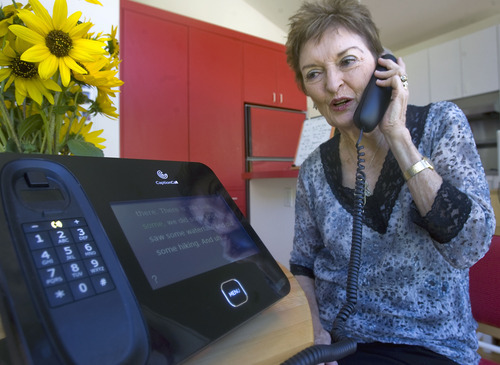
At 82, Shirley Ririe is losing hearing in both ears, and it was tough and sometimes embarrassing to use the telephone, she said.
"My most difficult thing is hearing people's names, and I'd have to ask them to spell it," she said about the start of every conversation on her home phone. "I'd say, 'I'm sorry, I don't know who this is,' or I would say, 'Who is this?' It's so embarrassing."
Sometimes, she would just try to fake her way through the conversation until she realized who was on the phone.
Not anymore. Now, Ririe is using a new landline telephone and service developed by Taylorsville's Sorenson Communications that allows people with partial hearing loss to have a phone conversation and understand every word.
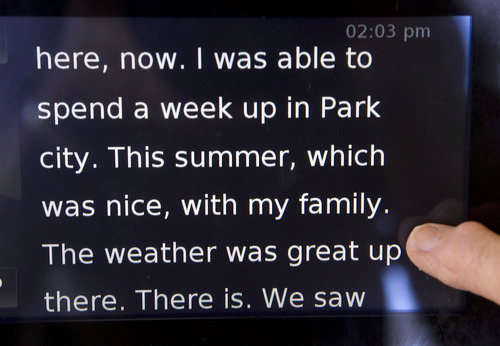
CaptionCall uses a telephone with a touchscreen interface, coupled with a transcription service and speech-recognition software that captions a conversation so people with partial hearing loss can also see what's being said on the other end of the line.
"I'm so happy with this phone," said Ririe, of Salt Lake City and co-founder of the Ririe-Woodbury Dance Company, who has been using the phone for a couple of months during the company's limited launch of the product and service. "This is the best gift I've ever had. It's so perfect for all my needs."
After an initial debut in California, Utah, Arizona and Florida, Sorenson will be making CaptionCall available nationwide this week. To purchase one, go to http://www.sorenson.com.
CaptionCall's $149 phone has a black-and-white touchscreen display for making one-touch calls, but it also displays text of what is said by the person on the other end of the phone. The phone is connected to both the telephone line and the Internet.
Here's how it works: If the person with hearing loss calls someone who is not hard of hearing, a "communications assistant" (CA) at Sorenson's Taylorsville call center listens in on one half of the conversation — what's being said by the person without hearing loss.
As that person speaks, the CA immediately repeats what is said on the fly into a headset, where speech recognition software trained for the assistant's voice automatically transcribes the words into text. That text is then sent via the Internet line to the CaptionCall phone used by the person with hearing loss. Because there is little lag between what is said and what is captioned, the conversation can flow in real time.
While users pay for the CaptionCall phone, there is no fee for the transcription service. Sorenson is paid through a surcharge on telephone bills that pays for telecommunications services for the deaf and hard of hearing under the Americans with Disabilities Act.
There are other similar phones and captioning services available, including the CapTel phone from Wisconsin-based Ultratec, but Sorenson chief executive and president Patrick Nola said "this is a world-class product" that makes several improvements.
"The display [scrolls] in a smooth fashion. Our latency is short. We brought it into the 21st century," Nola said.
The phone also has features that can improve the sound quality. There are settings to adjust the volume of the handset speaker beyond a normal phone, and you can adjust the frequency of the sound (people with partial hearing loss can hear certain frequencies better than others). It also is designed to reduce feedback and interference from electronic hearing aids, said CaptionCall's product manager, Robert Puzey.
"I've installed this across the country for college-age kids and 9-year-olds," he said. "Hearing loss can affect anyone at any age in life."
According to the Hearing Loss Association of America, 36 million Americans (17 percent) have partial hearing loss, making it the third-largest public health issue after heart disease and arthritis.
"The largest number of people who are hard of hearing fall in the category of in their 40s to 60s," said Michael Shelton, president of the association's Salt Lake City chapter.
"It's a great phone," said Shelton, who has tested the CaptionCall phone. "The advantages of the phone are that you just dial a regular number. It used to be in the old days, you had to dial in a bunch of numbers, and the captioning was quite slow. Now, it's improved upon that greatly. For a person who lacks confidence to talk on the phone because of hearing loss, it's a great thing."
Sorenson Communications is a provider of products and services for the deaf and hard of hearing and also makes a videophone and video relay service that allows deaf users to use American Sign Language with interpreters during phone conversations. The company just released an application for Android phones — and soon will for the iPhone — that works with its videophone.
Twitter: @ohmytech
Google+: +Vincent Horiuchi