









This is an archived article that was published on sltrib.com in 2011, and information in the article may be outdated. It is provided only for personal research purposes and may not be reprinted.
Most voices fall like water down the drain of our ears. Not Scott Carrier's.
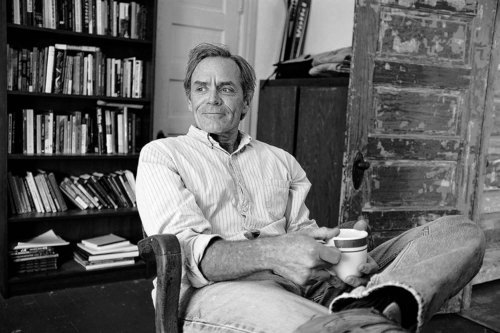
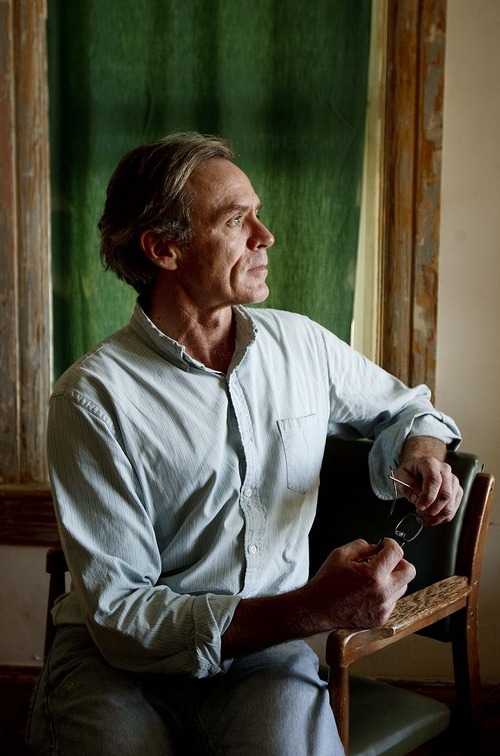
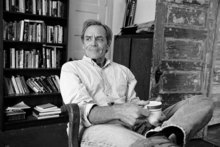
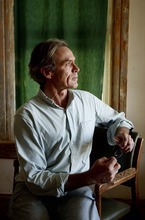
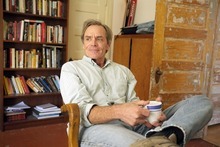
After taking in the angles of his face and measured aim of his eyes, the grit and resolution of his tone begins to form a terrain all its own.
That's no surprise for someone whose work in broadcast journalism has earned him a cult following after more than two decades of work in public radio.
What's remarkable is that the grain and terse grace of his voice rises just as distinctly from the printed word in his new book, Prisoner of Zion, available as an e-book from Amazon and audiobook on iTunes.
The anthology of 16 new and published works blends essay and on-location reportage, drawn from Carrier's post-9/11travels through Afghanistan and Cambodia for Harper's, Esquire and GQ magazines.
Mixing keen observations about foreign culture and America's own domestic myths and biases in the nation's "War on Terror," Carrier bars nothing from the reader's sight. He draws parallels between international troubles with his own ambivalence about Utah life, and even his own personal travails. The comparisons and contradictions stretch with originality, yet never feel strained.
Carrier's voice rings through every piece, calm in the face of atrocity, frank when confronting fanaticism, and precise in conclusions that never sell his subjects short.
—
Power from opposing forces • In "Shrapnel," his descent into a basement of Pakistani Taliban corpses in Afghanistan, a conversation with professed enemies of the United States becomes a physical wound of the soul, leading Carrier toward other paths to discover the origin of their hatred.
In "One Mighty and Strong," which was published in December in City Weekly and on the Mother Jones magazine website, Carrier analyzes the religious myths that shaped Brian David Mitchell in the lead-up to Elizabeth Smart's rape and abduction.
In perhaps the book's two most dazzling pieces — "The Source of the Spell" and "Najibullah in America"— Carrier juxtaposes his turbulent attempts to connect with his girlfriend and students in his Utah Valley University journalism classes across the broad landscape of Utah history, including the Mormon pioneers' massacre of Provo River Ute Indians, and the wars in Iraq and Afghanistan.
"I acted out of fear with my girlfriend. The Mormons acted out of fear with the Indians. The United States acted out of fear with the terrorists," Carrier writes. "Acting out of fear only makes the problem worse. This is the answer, the source of the spell."
—
Searching for "good tape" •Sitting down for a conversation at a local coffee shop, Carrier explains that his writing method is deeply rooted in radio, his first real journalistic love. His method is revealed in the backstory of his first big break, when in 1983 he hitchhiked across the country to appear at National Public Radio's Washington, D.C., headquarters with a bag full of cassette tapes.
"I still look for what I call 'really good tape,' and when I work in print I basically just try to get it right," Carrier said. "Narration is just a way to deliver actualities.
"With this book I feel like I'm transmitting an arc of people I know, people I've met. There's the sense that by following that arc there will be an answer as to why our country's falling apart, and why there's so much bitterness."
Carrier, 54, was raised in Salt Lake City in a Protestant family, graduating from Highland High School two years behind writer Terry Tempest Williams. His radio work has earned him some of journalism's most prestigious awards, including a 2006 Peabody Award, and his magazine pieces have been anthologized in Best American Travel Writing and Best American NonRequired Reading. After working as an independent radio producer, in 2006 he began teaching journalism at UVU.
In conversation, Carrier begins many stories in the way he launches journalism pieces, simple incidents becoming accounts of grand scale, tension mounting through carefully layered details. He's a writer who saves resolutions for the exact point when facts and descriptions have earned himthe authority of exposition. He's a writer in love with contradictions and opposing forces, regardless of format.
Two weeks after the Sept. 11 terrorist attacks, Ira Glass of "This American Life" asked Carrier to produce a radio piece. Carrier asked nine Americans whether they were ready to go to war. Carrier said he's still haunted by the words of a Vietnam Veteran and Green Beret with post-traumatic stress disorder who believed retaliation was futile, in contrast to the U.S. Marine officer who described the pride he felt after an attack on Fallujah, Iraq.
Opposing sides gripped his imagination again, Carrier said, during the 2007 debate between Salt Lake City Mayor Rocky Anderson and FOX News commentator Sean Hannity. With the crowd alternately cheering for Anderson or Hannity, both sides fell silent when Hannity displayed pictures of Kurdish children killed by Saddam's henchmen. Silence again greeted Anderson's display of Iraqi children killed by U.S. troops.
"The crowd's vast differences disappeared into one lake," Carrier said. "No one can handle the sight of dead children."
The mystery and the miracle is that both sides find a way to exist and operate, side-by-side, in the United States. As the pieces in his new book reveal, the fear that's gripped the United States since 9/11 has its origins not just across the world but also at home. Part of his motivation in writing Prisoner of Zion, Carrier said, was to document and study that fear. Or, as he says: "To see things clearly and call them by their proper names, to find a way to live without being afraid."
—
Relentless pursuits • Carrier launched his literary ambitions early at age 10, reciting haikus during his little league football team huddles.
An abiding interest in society's rituals and institutions led to a bachelor's degree in anthropology at the University of Colorado in Boulder, followed by a master's in mass communication at the University of Utah.
Both endeavors taught him to see the familiar in new ways, and even his own world as a primitive culture, he said. Hitchhiking across the nation in his first big gambit at journalism success, and recording adventures on cassette tape along the way, put that philosophy into action.
Alex Chadwick, then weekend producer of "All Things Considered," recalls the day a lobby guard told him a scraggly looking kid in his twenties wanted to talk to him about producing radio stories, and had tapes to prove the quality of his work.
"I always thought that in theory, and for public radio, even a hitchhiking kid ought to have the chance to produce a show. In practice, of course, it rarely works out," said Chadwick, now an independent journalist based in Southern California.
When a radio engineer came back to tell him the kid's work wasn't just acceptable, but very, very good, Chadwick moved Carrier into a D.C. men's shelter, eventually finding him an apartment.
When Carrier's 23-minute hitchhiking narrative hit the airwaves, it made him an instant legend in public radio and earned him the envy of journalists who had toiled for years without the chance to produce a piece that long.
"What they didn't get was that if they were really as good as Scott, they would get 23 minutes, too," Chadwick said. "Very few people in radio are that good for that long."
After years of his segments airing on NPR's "All Things Considered," Harper's published one of Carrier's radio pieces verbatim in 1997. That opened a floodgate of opportunity in print, culminating in a phone call from Esquire editor David Granger. "I want you to go to really f—ked up places and write about it," he told Carrier.
Carrier reported from Cambodia, and then Kashmir. Even after establishing a reputation as the prose poet of choice for worldwide conflict, Carrier still kept his ear open for pieces with a local bent.
His first book, 2002's Running After Antelope, collected Carrier's NPR stories in print. The title essay explores his obsession with running after antelope as a test of his biology professor brother's "running hypothesis," which argues that humans evolved as endurance predators. The story also makes an apt metaphor for Carrier's working method, say those who've worked with him. Like chasing antelope, Carrier's reporting runs on seemingly endless reserves of stamina.
—
Harmony in congruence • "There's a scariness to him, not in a way that seems angry, just resolute," said Art Silverman, a senior producer for features at NPR. "He's not someone I felt I could tangle with and, thankfully, I've never had to. Almost everything he turns in comes out perfect."
The book enjoyed positive reviews, but Carrier later quarreled with the publisher. Friends say that while Carrier's commitment to craft seals his reputation, it also translates into stubbornness.
"I'd give anything to be as odd as Scott, and have as keen a mind," said Anne Milliken, who worked with Carrier when she produced KUER's "Radio West" program. "I just wouldn't want to be as big of a pain in the a—. He doesn't suffer anything when it comes to his work."
His fidelity to craft churns in time to his love-hate relationship with Utah. Throughout Prisoner of Zion, Carrier vacillates between bewilderment and awe in the face of Mormon culture.
"The Tabernacle is the cosmic egg that holds the sound of the universe before the big bang," he writes in one story. "I used to want to leave and never come back, but now I see I'm held here. I am the prisoner of Zion."
And if Americans are ever to reconcile their differences, Utah's physical beauty might hold the answer, he says, while noting hoccurred on a stretch of highway in Montana.
Driving with the windows down a few months ago, Carrier's was the only car on the road. The writer said he was struck by the smell of prairie grass freshened by rain. The tarred scent of the fresh-paved road then weaved an acrid note. The rush of scent produced a strange harmony in its congruence, and once again a contradiction had somehow found resolution.
"It hit me really deep in my DNA, something ancient and primal," Carrier said. "All of a sudden the animosity of these two scents had dissolved in the natural world. Perhaps that's our only hope."
bfulton@sltrib.com Excerpt from "Shrapnel"
When you're in a war zone everything blends together — the horrible with the mundane, the threat with the smile, terror with yawns—and you never think about trying to keep things separate. At the end of the day you just want to sleep and there are things that can't be figured out, places you can't go for reasons you don't understand, sentences, comments you wrote down but don't make sense. Things happen all of a sudden and you're either there or you miss it. The only facts are dead bodies, everything else is hearsay quickly becoming mythology.
Later, after you get home, after the jet lag wears off and you stop waking up at 3 a.m. and driving around town, when you can form sentences of more than three words, when you can sit down and eat a meal with other people ... then the things that happen start to fall in line. You start finding names for things. You write about them, and if you do this well then the things go away.
But there are other things you can't call by name and so you can't write about them and they don't go away. They stay inside and you live with them, like shrapnel, your body grows around them.
Scott Carrier, from Prisoner of Zion Prisoner of Zion
By Scott Carrier
$6.99, Kindle edition, Amazon.com
$6.99, audiobook on iTunes
Info • www.prisonerofzion.com