










This is an archived article that was published on sltrib.com in 2012, and information in the article may be outdated. It is provided only for personal research purposes and may not be reprinted.
One was left outside a Korean city hall when he was 6 to 8 months old with a note pinned on his basket: "His name is Man-Ki Park, please take care of him, I can't take care of him any longer."
The other was abandoned outside a Chinese orphanage for unknown reasons when she was just months old.
Neither has learned much about an early past or bloodline, but both have found an identity and a future in a sport known for fostering individual expression and creativity.
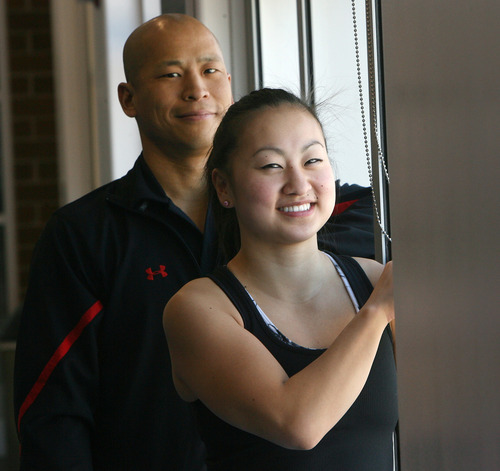
For Utah assistant coach Tom Farden and sophomore Corrie Lothrop, gymnastics has been a grounding force in their lives. While others fight to stay on the equipment, they have discovered a foundation in the twists and turns and leaps the sport demands.
"It's like a Rubik's cube," Farden said. "It's a humbling sport, and you have to figure out all the yellows and greens and then you see you are missing a couple reds or white. That is the beauty of gymnastics: It keeps your mind on something and gives you a focus. I didn't know that's what it was doing for me in my 20s and Corrie is still figuring it out, but it becomes part of your DNA."
It's part of their DNA for many reasons, first because both gymnast and coach gravitated to the sport naturally. Secondly, it's because they have very little evidence of their true DNA.
Lothrop, adopted by Jean and Don Lothrop when she was 2 years old, remembers nothing of her young childhood, especially of the time when she was in China. With no pictures, mementos or details of her mother's situation, Lothrop had no idea of the circumstances surrounding her birth until she visited the city of Wuhan, China, in 2008.
An alternate on the 2008 Olympic team, Corrie made the several-hour journey to the town to visit the orphanage with her family. No one was allowed in since they didn't have the proper government consent, but Lothrop didn't need to step foot within the walls to have a better understanding of her roots.
The city is known as the "Chicago of China," because it is home to many financial and transportation centers, but for Lothrop it was more a symbol of what she didn't have to do without if she had remained in the country.
"There was so much poverty; it was weird knowing that could have been me," she said. "Here, I am happy and healthy and I have a good life."
Lothrop is also a good gymnast — a very good one. Just a sophomore, already she has emerged as one of the top gymnasts in the country with 12 wins for the Utes. She was the least affected by pressure in Utah's Pac-12 meet, as she won the all-around title, scoring 9.9s on everything but the uneven bars, where she earned a 9.925.
Lothrop says gymnastics is natural for her, born out of an innate bundle of a "go get 'em" attitude that was channeled into gymnastics since her parents owned a gym.
"They always said I was a ball of energy," she said.
Farden believes it is more than that, even if Lothrop is unaware of it.
"There is part of you always trying to prove yourself when you are adopted," he said. "But I didn't realize that until I was older."
All that Farden knows of his childhood is that the first boy his given parents wanted to adopt died. He was picked out of a catalog — shopped like a piece of merchandise.
"I won the life lottery," he said.
A gymnast himself growing up in Minnesota, Farden believes his background motivated him and senses part of Lothrop's drive is from the same source.
"She has something to prove and has a little bit of a chip on her shoulder," he said. "There is that thought that just because I'm adopted doesn't mean I'm any less. When I was in my early 20s, I was out to prove to people I could be a good coach. Looking back, I didn't know what was driving me, but I know now and I see that in Corrie."
Farden says he has taken a special interest in Lothrop, believing their similar background helps him understand her frustrating moments as a person and gymnast. Utah coach Greg Marsden sees they have a special connection and encourages it, acknowledging their situations are unique.
"No matter how positive the experience is, you are going to have questions about it and emotional ups and downs," he said. "Tom has been a good mentor for Corrie. Different people handle things differently, and I'm not saying all adopted people have that same inner drive, but for both of them it has been a part of what has made them successful."
Both Farden and Lothrop say they don't spend much time consciously thinking about their past, but they are reminded of their beginnings in many ways. Neither has the typical mementos of first-birthday photos, family trees or stories of their parents. Both celebrated their birthdays last week — another reminder they are different.
Without any official paperwork, both were given random birthdays by their orphanages.
"We like to say we were the kids left on the doorstep," Lothrop said. "We do have our own connection. It's cool he has the same story as me."
What they do share is their gymnastics. It's a sport that requires balance and grounding, but just as much as it demands in those areas it has given the two.
"It is my life here," Lothrop said. "I don't think about the past much and I don't remember much and everything is vague, but I do remember Level 3 gymnastics."
Farden feels he is paying things forward a bit since he and his wife, also an adoptee, adopted a son four years ago from the city of Inchon, Korea, where he was abandoned. They have given their son the name Ki, in homage to his past.
The orphanage no longer exists, but like Lothrop, Farden didn't need to see a building to know his past.
He feels it and sees it in his son and in Lothrop.
"There are internal struggles you go through, and when I see Corrie going through them, I'm there," he said. "She has made major strides in maturity and outlook toward life, but what she does in the next four years is going to be very defining, as it is for anyone her age. But she is going to go through some things too, wondering why she was adopted, wondering what she is going to look like when she is older or if there are any health issues she needs to be concerned about. All those things will come up. She doesn't know what she is going to do in life yet, but it would surprise me if it wasn't something similar to gymnastics. It's part of her identity." —
NCAA Regionals
P Saturday, 6 p.m.
At the Huntsman Center
Who • Nebraska, Utah, Minnesota, Iowa State, Arizona State, San Jose State
At stake • Top two teams advance to the NCAA Championships April 20-22 —
Friday's practice schedule
At the Huntsman Center
Practices open to the public
1:15-3 p.m. • Utah, Nebraska, Iowa State
4-5:45 p.m. • Minnesota, Arizona State, San Jose State