

















This is an archived article that was published on sltrib.com in 2012, and information in the article may be outdated. It is provided only for personal research purposes and may not be reprinted.
Fewer Utahns will be racing for a breast cancer cure in Salt Lake City this year, as the Planned Parenthood controversy continues to reverberate here and around the nation.
Officials from the Utah affiliate of the Susan G. Komen for the Cure foundation say registrations are down significantly from last year, when 16,000 people walked or ran a mile or five kilometers to raise money for research and breast-health awareness. So far, said Debbie Mintowt, executive director of Utah's chapter, about 12,000 people have registered for the May 12 event, a 23 percent drop — and a loss of about $125,000 — for the organization's most lucrative fund-raising event.
"It's still a huge race and we still have a lot of supporters," Mintowt said. "Part of that is people don't really understand what we're doing with the money."
On Jan. 31, Komen announced it would no longer grant funds to Planned Parenthood due to new rules forbidding giving money to groups under federal investigation. Planned Parenthood, a political target for anti-abortion groups, was under congressional scrutiny at the behest of Republican Rep. Cliff Stearns of Florida, who questioned whether it spent public money on abortions.
The move led to a public-relations nightmare for the 30-year-old Dallas-based foundation, which quickly reversed itself on Feb. 3, apologized and said it would continue to give Planned Parenthood affiliates money for breast cancer screening programs. Donations to Komen dropped while donations to Planned Parenthood soared.
None of the Komen funds went to Planned Parenthood in Utah, which last received a grant in 2008 for $11,925 to print laminated breast self-examination cards designed to hang in the shower, said association director Karrie Galloway.
Despite the about-face, Komen chapters in Indiana, Arizona and Florida have seen 15 to 30 percent declines in race registrations, according to reports from organizers in USA Today and The Washington Post.
For years, some have criticized Komen for high overhead spending and the creation of what some detractors call a cult of the survivor, which presents breast cancer as kind of cute amid pink ribbons, balloons, stuffed bears and "I heart boobies" wrist bands. Barbara Ehrenreich scathingly wrote in "Welcome to Cancerland," a November 2001 Harper's Magazine article, "Certainly men diagnosed with prostate cancer do not receive gifts of Matchbox cars."
When this year's controversy ignited, Komen's Salt Lake City affiliate received several dozen critical emails. Comments on its Facebook page were mostly negative. Women vowed they would not run the race this year. Komen officials have said the struggling economy isn't helping.
—
Turning it around. • Komen is working to win back public approval, and is optimistic Race for the Cure numbers will rebound, said Leslie Aun, the organization's national spokeswoman. While she said she couldn't quantify the overall effects of the controversy in dollars, "there's no getting around the fact the numbers are down in some markets."
But in others they are flat or up, she said. About 16 Komen races will have been held by May 12, while the majority of the 135 races will take place in late summer and fall. And other fundraising efforts continue. "You can feel really good," Aun said, "that that money is going directly to save women's lives."
Mintowt said that this year, the Utah affiliate granted $635,000, or 75 percent of its net fundraising proceeds, to Utah organizations. She said 22 percent of the gross proceeds go to overhead and 25 percent of the net — $200,000 — went to the national organization, which doles out research-grant money.
A post-doctoral fellow at the Huntsman Cancer Institute is using a $180,000 grant to study how to isolate breast tumors and prevent the cancer's spread.
Evaluating the effects of the research donations is "tough," Mintowt said. "Strides have been made. Women are living longer."
On a practical level, the funds help women in many ways. Board president Lisa Schneider, in an op-ed published in The Salt Lake Tribune, totted up last year's achievements: More than 900 low-income and uninsured women received free mammograms; 128 breast cancer patients receive financial help for needs beyond treatment; 64 patients received hospice care; thousands of women learned how to reduce breast cancer risk.
A program Mintowt likes to highlight is Active Re-Entry in Price, which uses Komen money to fund 80 percent of the cost of Perkie Travels, a minivan transport system that takes people to Provo for radiation treatments five days a week.
Without Komen, "we wouldn't have a program," said Nancy Bentley of Active Re-Entry. The average age of their clients is in the mid-70s, women who would have to drive from seven eastern Utah counties up U.S. 6 — one of the most dangerous highways in the country — to get treatment they can't receive any closer to home. Imagine, Bentley said, "driving it every day for six weeks, with radiation treatments, when you don't feel so good."
—
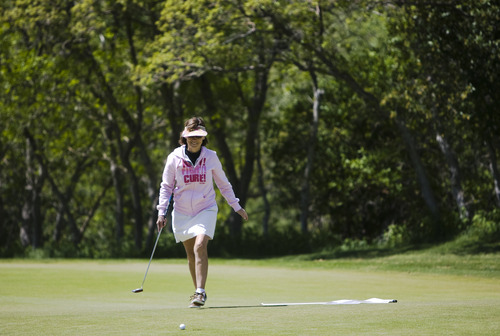
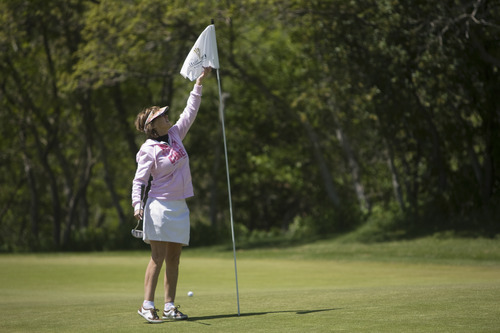
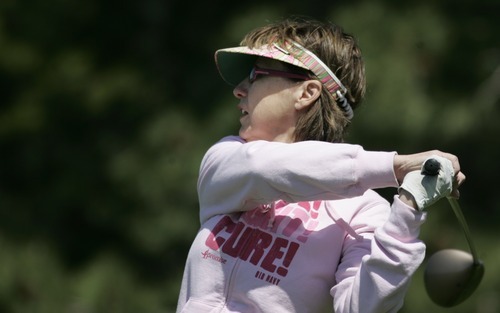
Never mind the pink. •Gail Winterfeld, who divides her time between Salt Lake City and St. George, is the top fund-raiser for Komen in Utah and has been a member of the grants council. Last year she pulled in $5,000. Already this year she's piled up $6,000, mostly from her family and friends.
"I am not embarrassed to ask them for help," Winterfeld said. "Even though I'm the one who had cancer, they were affected, too. People took it very personally. I say, 'Look, we have to end breast cancer. Another person, another family member, can't go through this.'"
She adds: "They've got to get in and get their mammograms. My breast self-exam saved my life."
Winterfeld understands some people feel overwhelmed by all the Komen pink cuteness. "I don't bother to defend it, if that's the visual that gets people to think about breast cancer," she said. "We would welcome a better idea if we had one."
If nothing else, the awareness campaign has made it possible for Americans to utter the word "breast," she said, though even she is a bit uncomfortable with the label "survivor."
"They never say, 'You're cured.' You're a survivor," she said. "You really are a victim."
It worries her that Utah women rank second to last when it comes to getting mammograms. "For such a state that touts family values," Winterfeld said, "how can you be a family if you're missing a mother?"
She will walk the 1-mile course on May 12. She knows people continue to feel strongly about the Planned Parenthood debacle. But she remembers what it was like when she was in treatment.
"Sitting in the chemo room, looking around, they were just average women," Winterfeld said. "I'm happy to be associated with Komen despite what happened." —
Susan G. Komen Race for the Cure
The Salt Lake City Race for the Cure will be held Saturday at Library Square in downtown Salt Lake City.
The 1-mile walk starts at 8 a.m.
The 5K run starts at 8:30 a.m.
Organizers say that so far, the number of registrations is down from last year but they will allow people to sign up through the race day, when registration opens at 6:30 a.m. For more information on how to register online or by mail: http://bit.ly/JjR3Yk —
Utah and funding
No recent funds from the Susan G. Komen foundation have supported Planned Parenthood in Utah, which last received a grant in 2008 for $11,925 to print laminated breast self-exam cards designed to hang in a shower, said association director Karrie Galloway.