







This is an archived article that was published on sltrib.com in 2012, and information in the article may be outdated. It is provided only for personal research purposes and may not be reprinted.
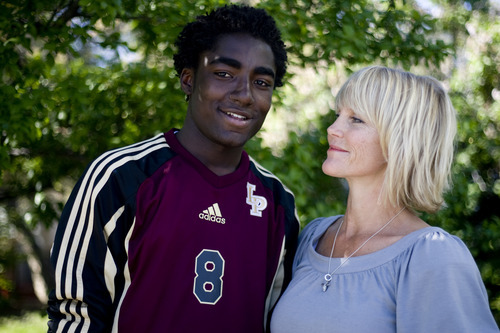
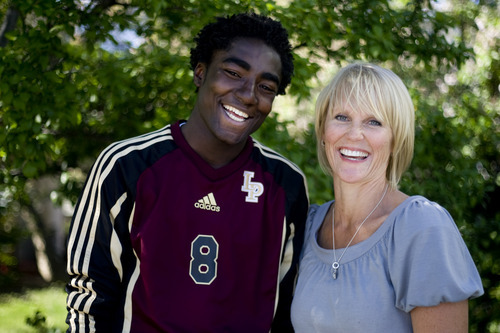
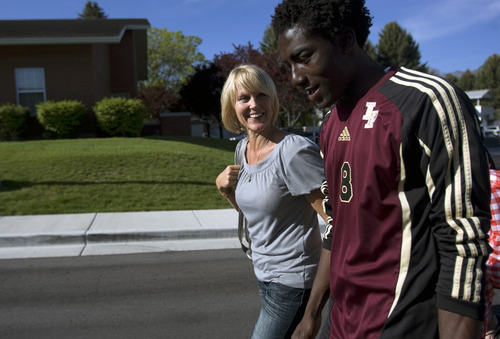
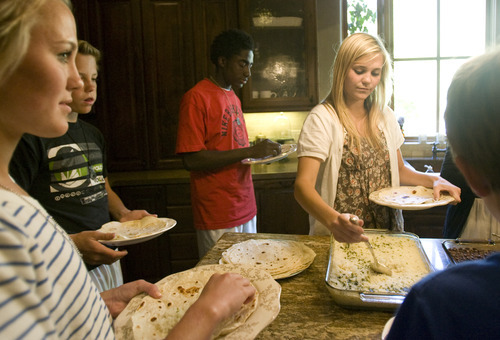
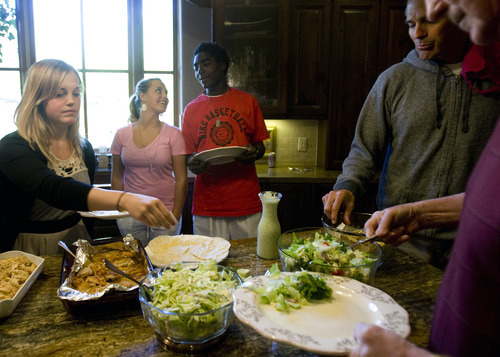
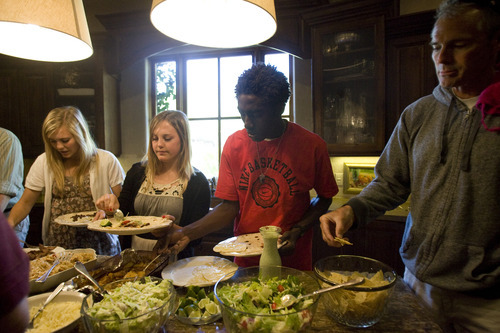
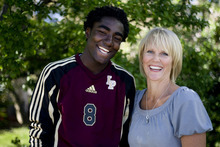
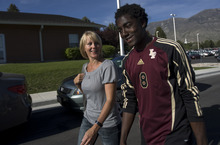
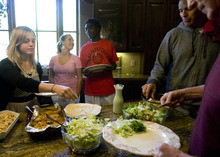
"Twi! Twi! Twi!" The six blond children are chanting, demanding that their brother offer the dinner blessing in novelty fashion. "C'mon, you won't say it in Twi?" asks his father. "It's your first language!" yells his oldest sister. "No," he insists. "English." The youngest brothers inch toward the steaming mounds of chicken and rice. In the stately home, tucked in the crease where Alpine's valley floor meets the Wasatch Front, the 18-year-old Ghanaian glances awkwardly at the family he is still getting to know, and which is still adjusting to him. His mother, standing nearby, coaxes him with a gentle expression. Taking her cue, he instructs everyone to close their eyes. Kofi Johnson begins to pray.
—
Her veins were green when she died.
Francis Kofi Glover watched his mother die in 2002 in the village of Peki, at his grandmother's home in Ghana's Volta Region, after his father's other wife, in a fit of jealousy, sent a serving of his mother's favorite meal. She didn't suspect the poison.
Kofi was 8. It took Cecilia Kumagro three days to die.
Life in western Africa is vastly different from life in America — unless you're homeless. Then the routine is similar, even in Accra, Ghana's capital.
After his mother's death, with nowhere to live, Kofi slept from midnight to 5 a.m., the hours when vendors at the market in Accra vacated their tables. If one returned while Kofi was sleeping, the vendor would dump water on the boy and call the police.
Kofi eventually found his way to the Odo ne Asumdwia (Peace and Love) orphanage funded by local TV host Grace Omaboe, known as Maame Dokono, whose hair his mother had styled.
He spent six years at Peace and Love as one of an estimated 263,000 orphans living in Ghana in 2010, according to KaeMe, a California-based organization that seeks to reconnect orphans with their families.
Controversy swarmed Peace and Love, but Kofi didn't notice. According to Ghanaian media reports, the orphanage operated without a license for two years, and the 60-plus children, most younger than Kofi, lived in dark, dank rooms. They weren't fed. Some were sodomized.
"If you got used to it," Kofi says, "you survived."
Maame Dokono would be acquitted of neglect, but that was the end of Peace and Love.
On the day the orphanage closed in February 2009, Kofi and another teen helped the smaller children pack. With a large man yelling at them to hurry, they helped the children pull on shoes, most several sizes too small.
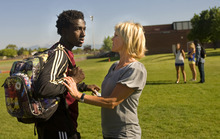
Amid the frenzy, Kofi noticed a petite blonde pointing at him.
—
Shelley Johnson, who pointed, asked why those two boys were so much older?
The scene wasn't what the Alpine mother of six expected when she agreed to shuttle children from a befouled and hazardous orphanage.
Africa had always fascinated Shelley, the wife of former NFL punter and BYU star Lee Johnson.
"Ever since I was little," she says, "and I saw those kids with big bellies on TV."
She donated money and volunteered at home. And when her friend Julie Reneer learned in 2009 of a boy in Ghana who needed a family, Shelley pleaded with her husband to let her go along.
Julie already had three children but didn't feel like her family was complete. Shelley didn't yet recognize that quality in herself, but it was there.
She intended the trip to Accra as an adventure, but partway through, Shelley began to feel guilty that she had done nothing charitable on the trip.
She agreed to help transport children from the shuttered Peace and Love to another orphanage.
When they arrived, the Utah mothers found chaos.
"We went there," Shelley says, "and it was so sad."
In the van, Shelley leaned over a seat and spoke to the boy she'd noticed earlier. He told her his name was Francis, but that his African name was Kofi.
As he worked a sucker with his mouth, a gift from the Americans, Shelley prodded.
Do you like sports?
Soccer.
Do you play an instrument?
Drums.
She felt an immediate bond with this boy who played drums in his church band and loved sports. Her kids play violin and piano, music often floating to the rafters. And soccer!
It was time to go, but she gave Kofi her phone number and urged him to call if he ever wanted anything from America. They said goodbye.
Shelley and Julie returned home, Julie's new son Paapa Yaw between them. Shelley told stories of Ghana and especially of Kofi. She dreamed of bringing him to Utah, perhaps on a temporary basis to give him an education and, for a while, a family. Then he could return.
But the realities of home took over.
"I'm a super-busy mom," she says, "and I had no business thinking that way."
Two months later, the telephone rang.
"This is Francis," the boy said.
She nearly dropped the phone and turned to Lee.
"Oh my gosh," she said. "That was the boy I was telling you about."
—
Kofi wanted soap and deodorant. From the land of opportunity, the home of Apple and Nike and hope, he wanted hygiene products.
Shelley hurried to put together a package, which also included cleats for soccer.
At home, she started talking about Kofi again. She asked Lee if they could adopt him.
"I probably wouldn't have gone down that road," says Lee, who spent 18 years in the NFL, including 11 seasons with the Cincinnati Bengals. "I have six kids."
But he saw the commitment in his wife's coaxing eyes and said, "Sure."
In February, Kofi was called to the office of Helena Obeng-Asamoah, known as Auntie Helena, the director of all orphanages in Ghana. He wore his nicest shirt.
He met Shelley there, but adoption isn't that easy. She met daily with government officials.
They battled over documents.
What birth certificate? A death certificate for his mother? Are you crazy?
"At one point, I said listen, his mom died in a village," Shelley says. "He saw her dead, the village saw her dead. You know as well as I do there's no death certificate."
Letters on her behalf arrived from the office of Sen. Orrin Hatch.
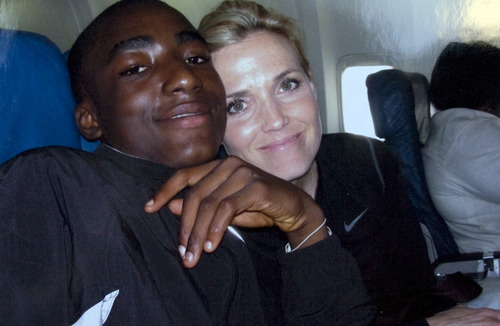
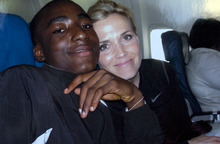
They flew home at the end of February 2010. Kofi packed his large African drum in a padded case designed in kente, a Ghanaian pattern bright with colors, which is seen on clothes and buildings. The drum slung over his shoulder and wearing a soccer jersey, he climbed the stairs of the plane.
As they took off, Shelley handed Kofi a camera. He snapped one angled photo: the blocks of Accra and their dirt borders. He keeps that photo in a black album, along with the others of him smiling, head resting on Shelley's shoulder.
It wouldn't always be this easy.
—
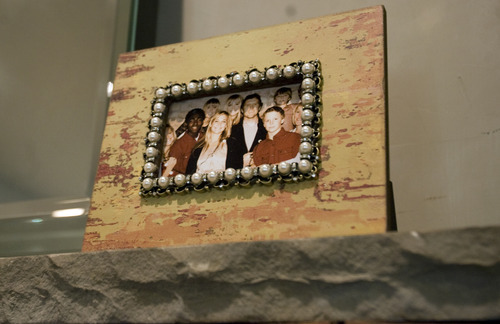
On Sunday, each of the seven kids is home.
Kofi, 18, plays a game of rugby golf, a made-up family game, in the backyard with Caleb, 10, and Bo, 13.
"Backboard," he says, angling his foot toward the basketball court 60 feet away. "Two tries."
He punts the ball long and to the right; Lee yawps a critique. Still lean and athletic, Lee, 51, plays soccer with the kids and punts a rugby ball to show off.
Shelley calls for dinner. They pray, with Kofi reluctantly offering the blessing in Twi. When Kofi first arrived in Alpine, one of his sisters requested that missionaries from The Church of Jesus Christ of Latter-day Saints come speak to him. Each time they knocked, he hid. One day, he wondered why they cared enough to keep coming back.
He listened.
Six months after moving to Alpine, he was baptized.
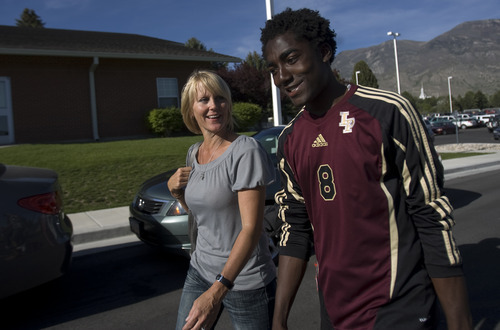
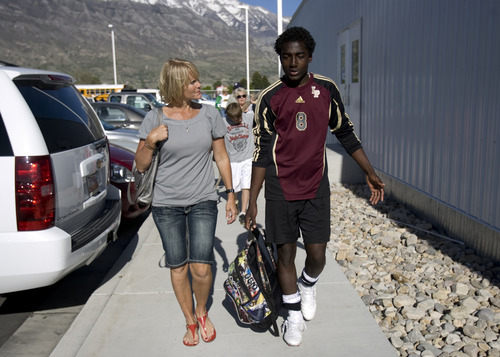
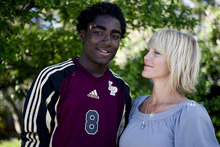
In the fall, Kofi was Lone Peak High School's homecoming king and he is a defender on the Lone Peak soccer team, which enters this week's Class 5A state tournament as the No. 1 seed from Region 4. He was briefly a football player. Lee taught him how to punt, but that lasted only a week. After a lineman rolled on his ankle, Kofi worried about his soccer career.
That wasn't his only collision at school. Once, a classmate took a photo of Kofi, manipulated it to make him look like a warlord, and, as a play on the "KONY 12" movement to capture Ugandan guerilla group leader Joseph Kony, labeled it, "KOFI 2012."
Kofi doesn't understand why Americans find humor in being mean. It's not that way in Ghana.
"I don't think it's funny for kids here to joke about it," he says.
—
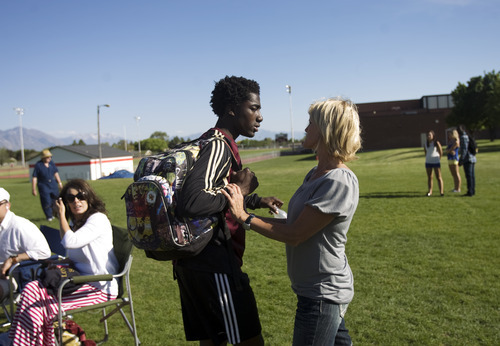
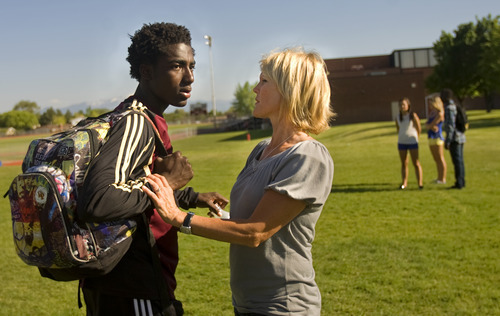
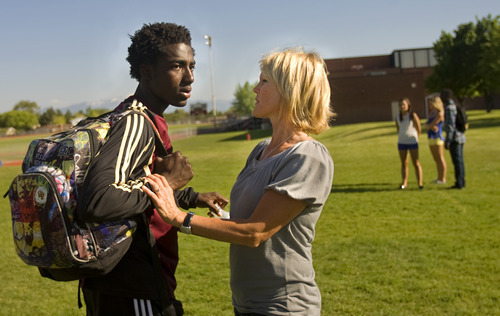
There's other tension, too. Kofi and Shelley have battled. Doctors and experts cite detachment issues.
Children who grow up in orphanages often struggle to function in families.
"You are the bravest couple I have seen," Auntie Helena wrote in an email to the Johnsons, "adopting a child from Ghana of that age."
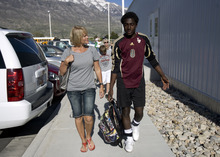
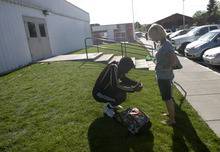
Kofi complained of mowing the lawn "with my muscles," while neighbors rode lawn mowers. In some ways, Shelley fears Alpine's affluence has ruined the boy.
"She was hoping Kofi would just come, and she would just plop him into how she raised her other kids," says Julie, whose son Paapa Yaw is now 5. ''This is what we do, and this is life."
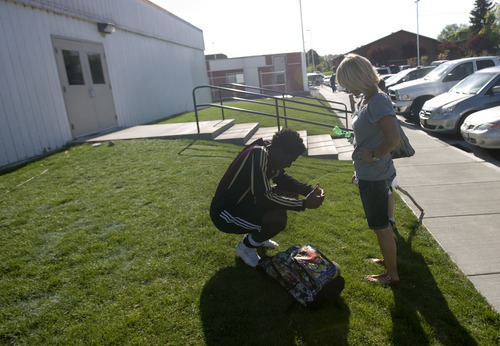
Shelley provides an example of why she and Kofi have clashed. He doesn't like to take off his shoes in the house, even when Shelley asks.
She addresses him.
"It seems so easy just to say, 'OK,' just because you know how much that means to me. Why is that a fight we have to start today? Why is making your bed a fight?" her voice rising in urgency but not much in volume.
"And it's because you feel like you're an adult, you should be able to do what you want to do, but you also came into a home where we already had rules established."
It sounds like a speech she had given before.
"In my country," he says, "I was already raised and I already knew everything I wanted to know in life."
He remains connected to Ghana, thanks to Facebook. His friends there have seen the photos of him in new clothes and with beautiful dance dates.
"They always think I've forgotten about them, and that's really difficult for me," he says.
—
The night winds down; the children disperse.
Kelsey, 22, texts beneath a blanket outside. Next to her, Bo watches a music video on YouTube.
Kofi begins juggling a soccer ball with his head.
"What's your record, bro?" Lee shouts from the patio.
"That was like 20," Kofi responds.
"Twenty? I could do 20 right now, bro," Lee says, so Kofi heads the ball to him. He passes it back.
Between them, they exceed 20 passes.
Their relationship is playful and easy.
Shelley doesn't have the soccer skills to break through Kofi's barriers. She feels they're running out of time, at least like this. Kofi will move into an apartment in a month, and attend an alternative school in Orem to earn his diploma after attempting to cram four years of education into two. If he's finished by August, he will move to Arizona to try out for a junior-college soccer team.
Shelley thought she knew how to be a mom, but she and Lee were forced to rethink their parenting philosophies.
"We, before him, were living in a fantasy land," Lee says. "We had kids, they didn't misbehave. He's made us normal."
In Ghana, Shelley saw an independent boy who got around the city on his own, who helped other children.
"I adopted him at the busiest time of our lives and thought what I saw in Africa would be exactly what I would get here," she says.
Instead, the pair have struggled. Shelley says they often don't get along.
But she still sees the potential in her son and remembers the moments in Ghana that convinced her to adopt him. In the same kind of market that once sheltered Kofi, vendors one day bombarded Shelley. The teen stepped in and "just started protecting me and screaming," she says.
He's just as protective of his brothers and sisters, she adds. She wants him to build on that and adapt to other ways of family life, too.
"I just remember thinking this kid is so protective he would fight to the death for us," Shelley says.
She pauses.
"I know he loves me."
boram@sltrib.com Twitter: @oramb