


This is an archived article that was published on sltrib.com in 2012, and information in the article may be outdated. It is provided only for personal research purposes and may not be reprinted.
Utah Olympic Park
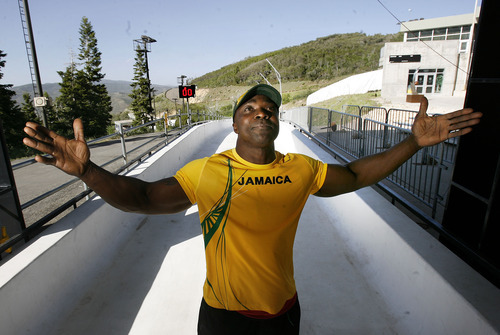
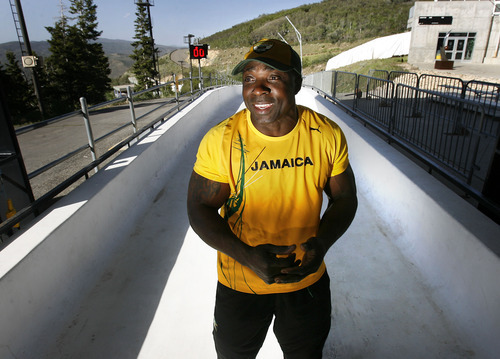
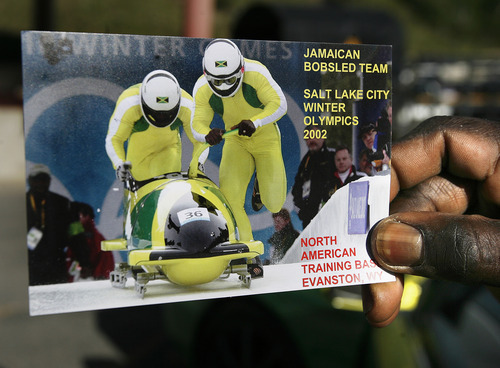
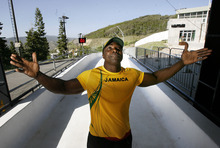
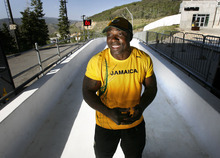
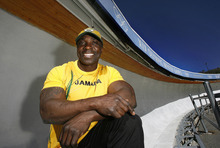
Driving a low-riding car painted green, yellow and black to resemble a Jamaican bobsled, Winston Watts parks at the top of the Olympic track, steps out into the mountain air and relives the best five seconds of his life.
He's back at the start of the bobsled course, and where this latest journey ends — assuming it gets anywhere at all — is anybody's guess. The Jamaican bobsledders, made famous by Disney and validated by recent Olympic performances in Canada, are seeking sponsors and making a run at the 2014 Games in Sochi, Russia.
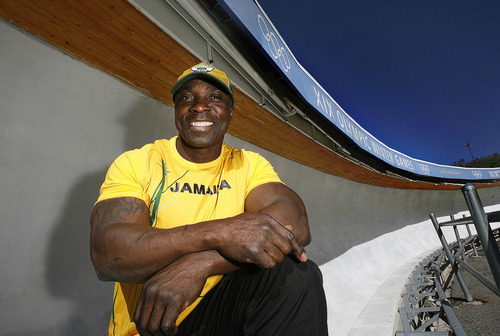
They're led by an athlete who will have turned 47 by then and describes himself as "one of the best-known guys" where he lives: Evanston, Wyo.
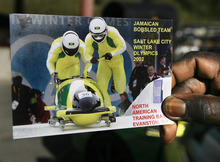
A military veteran and former high school track and field athlete, Watts joined the Jamaican bobsled program in 1993, in time to help promote "Cool Runnings." The movie, a fictionalized account of the team's initial Winter Olympic showing in 1988, served as a nice marketing vehicle, even if not everyone took seriously the ice-track pursuits of a Caribbean island nation.
Outsiders "used to think we're a bunch of jokers," Watts said. "They figured out we're not jokers. We're serious competitors like everybody else."
Watts proved that in 2002, teaming with brakeman Lascelles Brown to break the two-man start record on the Olympic course. They faded from that point, thanks partly to an inferior sled, finishing 28th among 37 teams. That remains the last appearance of Jamaican bobsledders in the Games. Watts retired after an unsuccessful effort in 2006, only to attempt a comeback that Paul Skog, Evanston's biggest bobsled advocate, describes as "absolutely, 100 percent realistic."
Evanston, Jamaica, bobsledding. Those words never appeared together until Skog figured the convergence of "Cool Runnings" and the 2002 Olympics, staged 60 miles from the town of 12,000 residents just across the Wyoming border, offered a marketing opportunity. Skog, now the city's prosecuting attorney, made Evanston the official headquarters of the Jamaican bobsled team.
The town provided housing and workout facilities, gaining publicity and a connection to Utah's Olympics in return. Skog even dared to imagine the Jamaicans liking the town so much that they'd want to live there.
Seven years after returning, seeking a new life after a failed marriage, Watts is a U.S. citizen and a permanent Evanstonian, winter weather and all.
"I can't believe he's been here as long as he has," said Dennis Poppinga, the town's parks and recreation director. "He's meshed into the community."
One of his daughters graduated from a junior college in Rock Springs, and Watts intends to move his mother to Evanston this summer.
Watts now punctuates most sentences with "man" — not "mon" — but he embodies the outgoing personality associated with Jamaicans. Having worked for six years in the natural gas and oil fields before being laid off, he recently joined a company that monitors industrial safety.
Even his name became Americanized in the naturalization process, after he competed in three Olympics as Winston Watt. Brown, meanwhile, turned Canadian. He's now competing for Monaco, which is another story. Yet if anyone legitimizes this renewed effort of Watts and the Jamaicans, it is Brown. By winning silver and bronze medals with Canadian teams in 2006 and 2010, he showed the country that produced track sprinters Usain Bolt and Yohan Blake can develop successful winter competitors.
Winning requires money, though, explaining Brown's changing affiliations. "I know what equipment does, having the resources," Brown said. "Winston can do it, he just needs help."
Skog is determined to help Watts bring Jamaican athletes to Evanston and get a team on the track in November, competing at the Utah Olympic Park and in Canada. In the funding quest, "We'll start at the bottom, go locally and knock on doors," Skog said. "I don't think we'll have a problem."
As for the issue of competing in his mid-40s, the 6-foot, 235-pound Watts offers his own evidence, saying he's in excellent shape — "as you can see."
Long before he even thought about 2014, there was another sign. Among the Wyoming residents who joined Watts in his naturalization ceremony was a woman whose hometown is Sochi, Russia.